Regulatory energy audit in industry: who is affected, what does it contain, and how to prepare for it?

Léo
•

Regulatory energy audit in industry: who is affected, what does it contain, and how to prepare for it?
Article L.233-1 of the French Energy Code requires a regulatory energy audit to be carried out every 4 years. Since October 1, 2025, the obligation no longer targets only large companies: it now depends on the actual energy consumption of the site. This is an obligation that many industrial operators are vaguely aware of, but whose scope they underestimate, both in terms of the penalties incurred and the actual value that the audit can bring when properly prepared.
This article outlines the obligations, the expected content, the possible alternatives, and how an IIoT data infrastructure changes the nature of this process.
Who is affected?
The DDADUE Law No. 2025-391 of April 30, 2025, which transposes the European Directive 2023/1791, replaced the old size criteria (250 employees, €50M turnover, €43M balance sheet) with a single criterion: the average annual final energy consumption, across all energy vectors, calculated over the last three calendar years.
Two thresholds apply:
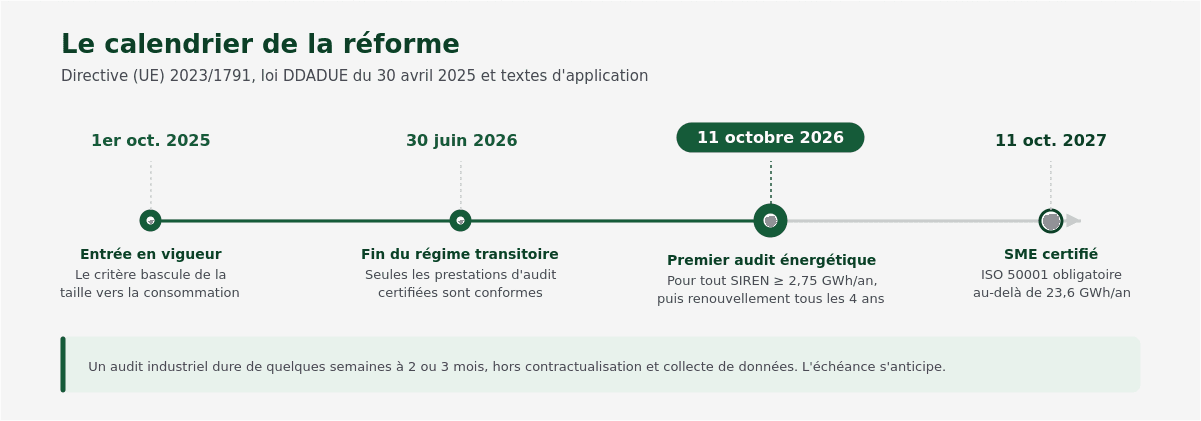
from 2.75 GWh/year (10 TJ): mandatory energy audit, to be completed before October 11, 2026, then every 4 years;
from 23.6 GWh/year (85 TJ): implementation of a certified ISO 50001 energy management system, before October 11, 2027
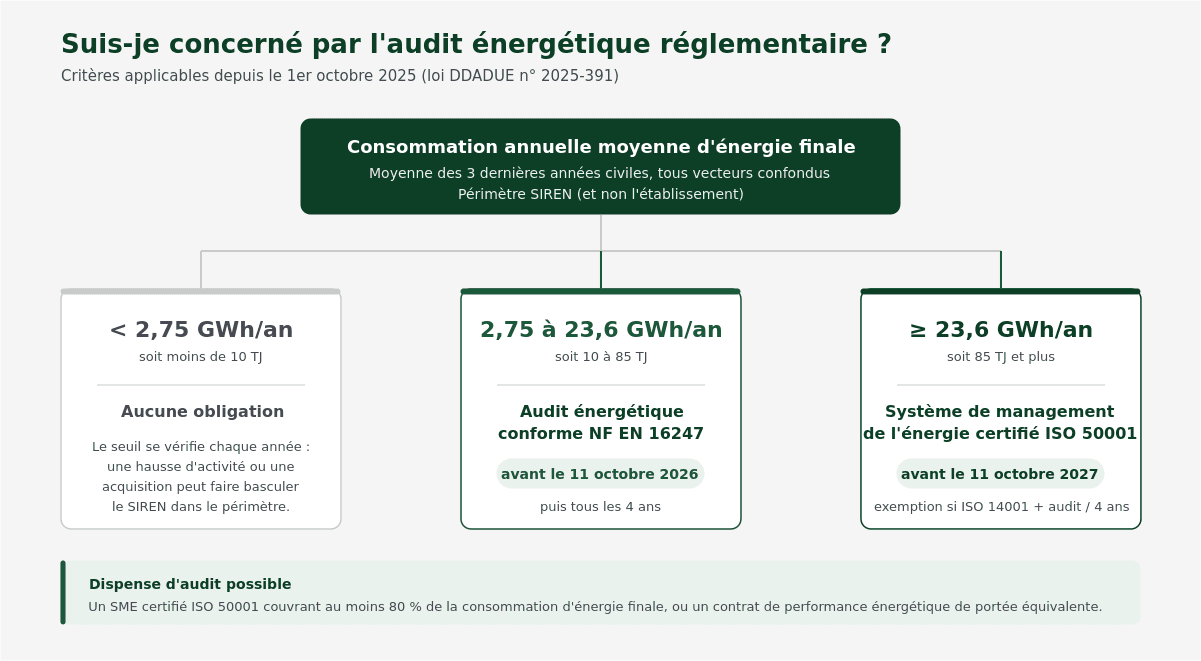
Thresholds are assessed at the SIREN level, not the individual site: a multi-site industrial operator may exceed the threshold collectively, even if no single site exceeds it on its own. Companies that remain below 2.75 GWh/year are not affected, but the calculation is recalculated annually.
The audit must be carried out by a qualified auditor, cover at least 80% of the company's energy consumption, and be submitted to ADEME within the specified deadlines. Note on this point: the decree of July 10, 2025 shifted the recognition of auditors from a provider qualification model (RGE étude, OPQIBI) to a service certification accredited by COFRAC. The transitional phase ended on June 30, 2026, and only certified services are now recognized as compliant.
Not sure if your site is affected?
Penalties for non-compliance
Failure to comply with the audit obligation exposes the company to financial penalties:
up to 2% of annual turnover for a first offense;
up to 4% in case of a repeat offense.
Enforcement is carried out by the DREAL. Beyond penalties, an unperformed or poorly prepared audit represents a missed opportunity: it is the ideal time to formalize an energy action plan and secure available funding.
The alternative: ISO 50001 certification
Companies certified ISO 50001 are exempt from the regulatory audit obligation, provided that the energy management system covers at least 80% of the final energy consumption. An energy performance contract of equivalent scope provides the same exemption.
This is a relevant alternative for manufacturers who wish to structure their energy efforts sustainably rather than simply responding to a periodic obligation. Above 23.6 GWh/year, the choice is no longer optional: ISO 50001 becomes mandatory. We detail this process in our article on implementing an EnMS to monitor and optimize your energy consumption.
Penalties for non-compliance
Failure to comply with the audit obligation exposes the company to financial penalties:
up to 2% of annual turnover for a first offense;
up to 4% in case of a repeat offense.
Enforcement is carried out by the DREAL. Beyond penalties, an unperformed or poorly prepared audit represents a missed opportunity: it is the ideal time to formalize an energy action plan and secure available funding.
.
Preparing for your regulatory energy audit?
To go further: the benefits of IIoT for industrial energy management | industrial metering plans | DAT'Process for process optimization | all our articles