Energy Management System (EMS): definition and driver of adoption in industry

Axel
•

Energy Management System (EMS): What It Is, and Why Manufacturers Are Adopting It
Controlling energy consumption is no longer just a budget concern. Between volatile energy prices, regulatory mandates (BACS decree, ISO 50001), and CSR commitments, manufacturers require tools to convert energy data into decision-making leverage. This is precisely the function of an Energy Management System, or EMS.
But concretely, what does this entail? And how do you choose a solution tailored to an industrial production site?
What is an Energy Management System (EMS)?
An EMS is a software platform that centralizes, tracks, and analyzes energy consumption across a site or a portfolio of sites. It collects data from field meters and sensors (electricity, gas, compressed air, water, heat, etc.), stores historical data, and processes it into energy performance indicators (IPE) that can be utilized by operational teams.
The acronym EMS is often used interchangeably with EnMS (Energy Management System) or EMIS (Energy Monitoring and Information System). In an industrial context, this is also referred to as energy supervision or multi-site hypervision.
What distinguishes an EMS from a simple meter-reading tool is its ability to:
• Correlate consumption with production activity (to calculate actual specific consumption),
• Trigger alerts in the event of deviations from a baseline or a threshold,
• Aggregate data from multiple sites into a consolidated view,
• Populate regulatory reporting without manual data entry.
EMS vs. SCADA vs. BMS: What Are the Differences?
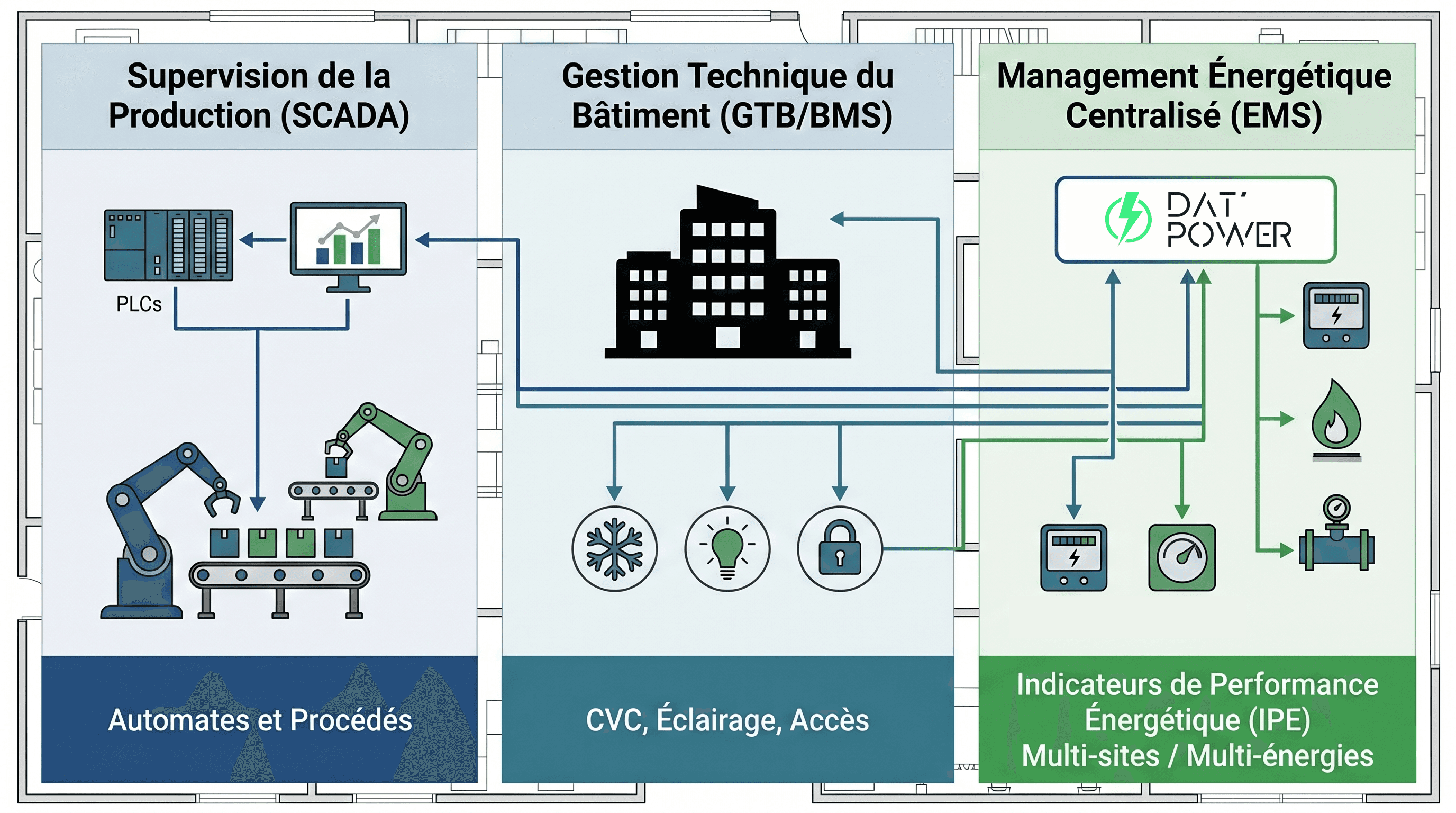
All three tools handle field data, but their scopes are distinct:
• A SCADA system supervises industrial processes in real time (PLCs, process sensors) often using control-command logic. Its primary focus is production, not energy.
• A BMS (Building Management System) controls HVAC equipment, lighting, and building access. It is primarily designed for commercial buildings.
• An industrial EMS focuses on energy flows, across all energy vectors, at the production site or multi-site level. It interfaces with the SCADA system to retrieve contextual data without replacing it.
Within DATIVE's IIoT environment, the DAT'Power platform serves as this industrial EMS: featuring multi-protocol data collection (Modbus, LoRaWAN, M-Bus, OPC-UA, etc.), energy dashboards, smart alerts, and multi-site management.
What Concrete Problems Does an EMS Solve?
Energy bills are rising, but the cause is unknown
On a non-instrumented industrial site, identifying the cause of a consumption spike requires several days of field investigation. With an EMS, disaggregated load curves allow teams to pinpoint the issue within minutes: equipment running outside of production hours, a power drift on a specific workstation, or an unexplained nighttime consumption peak.
Energy reporting is time-consuming and unreliable
Without a dedicated tool, energy balances are compiled using manually populated Excel spreadsheets, introducing risks of error and lost time. An EMS automates the generation of indicators, periodic reports, and regulatory compliance documents.
Inability to manage performance across multiple sites
Multi-site industrial groups struggle to compare performance between production units because data is not structured consistently. A unified EMS standardizes indicators and provides a consolidated view, site-by-site or by geographical zone.
Essential Requirements for an Industrial EMS
Not all EMS platforms are designed for the constraints of a production site. Here are the essential technical features:
• Multi-utility and multi-protocol data collection, compatible with existing legacy equipment,
• Calculation of IPEs correlated with production data,
• Configurable alerts for threshold overruns or drifts,
• Multi-site management with data consolidation,
• Automated export and reporting for audits and regulatory requirements,
• Cyber-secure architecture (IT/OT network segmentation, secure hosting).
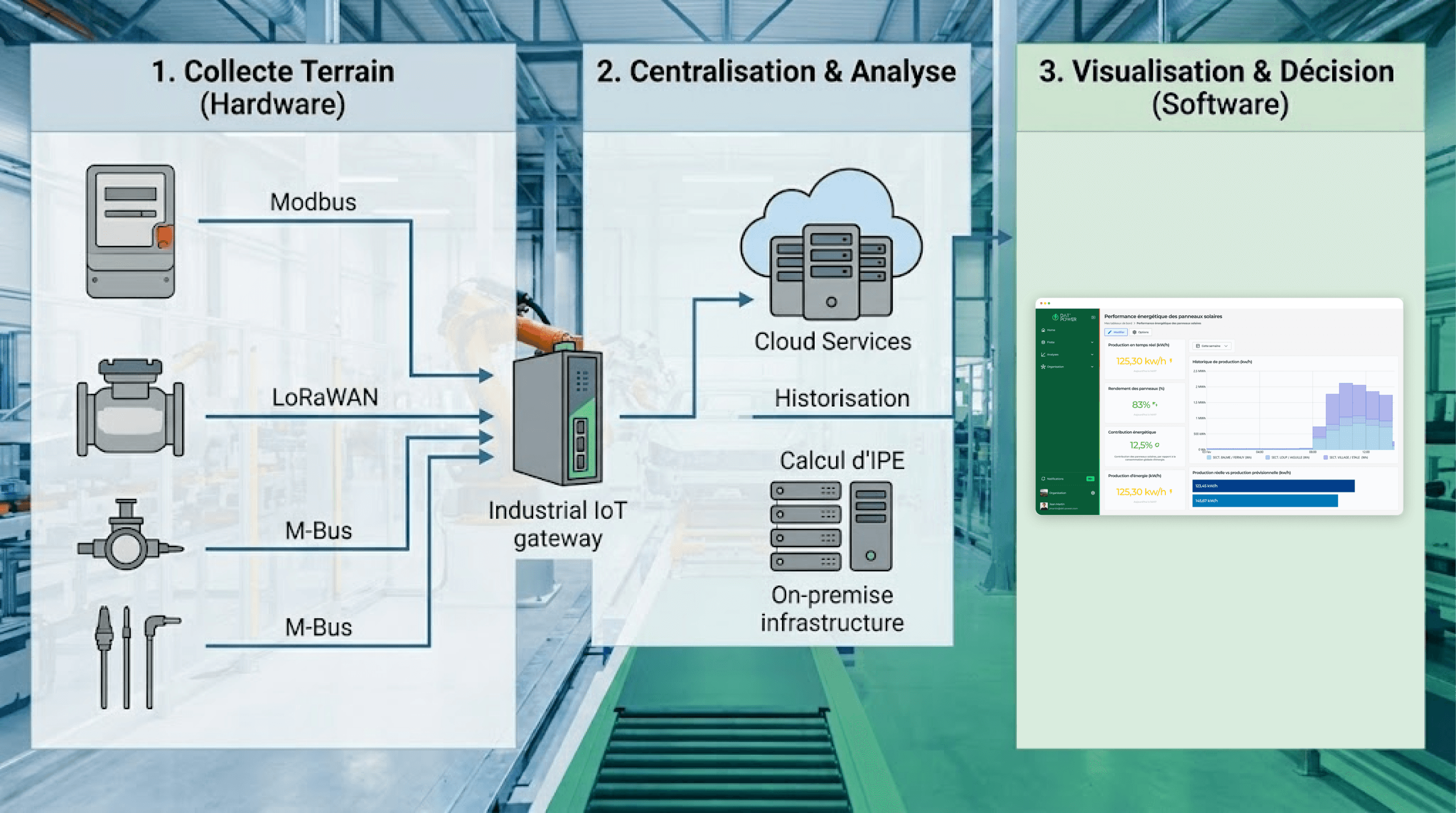
To learn more about the measurement chain, the integration of Carlo Gavazzi meters with DAT'Power demonstrates how raw data is converted into actionable dashboards.
Discover DAT'Power, our energy management platform
EMS and Regulations: What You Need to Anticipate
The ISO 50001 standard requires the implementation of a structured EnMS, including documented IPEs, measurable objectives, and regular reviews. A properly deployed EMS serves as the technical foundation for this process.
The CEE IND-UT-134 scheme (energy performance indicator measurement system) provides funding to offset a significant portion of the project via Energy Savings Certificates. Eligibility depends on a formalized metering plan and a compliant monitoring solution. DAT'Power is eligible for this program.
The BACS decree, which applies to commercial and industrial buildings with systems over 290 kW, mandates the installation of building automation and energy control systems by 2027-2030. The "décret tertiaire" complements this framework regarding consumption reduction targets. An EMS addresses the monitoring requirements of these regulations.
Where to Begin?
Before selecting an EMS, the first step is to formalize an industrial energy metering plan: identify significant energy uses (UES), define priority measurement points, and select appropriate sensors. This phase structures the entire project.
DATIVE supports manufacturers from this initial phase through to the deployment of DAT'Power, using a phased approach adapted to production constraints.
Discuss your project with a DATIVE expert
Related articles
• Industrial metering plan: The first step toward energy performance