Deploying an energy management system on a high-threshold SEVESO site: DAT’Power 2025 customer case study

Thomas Peyron
•
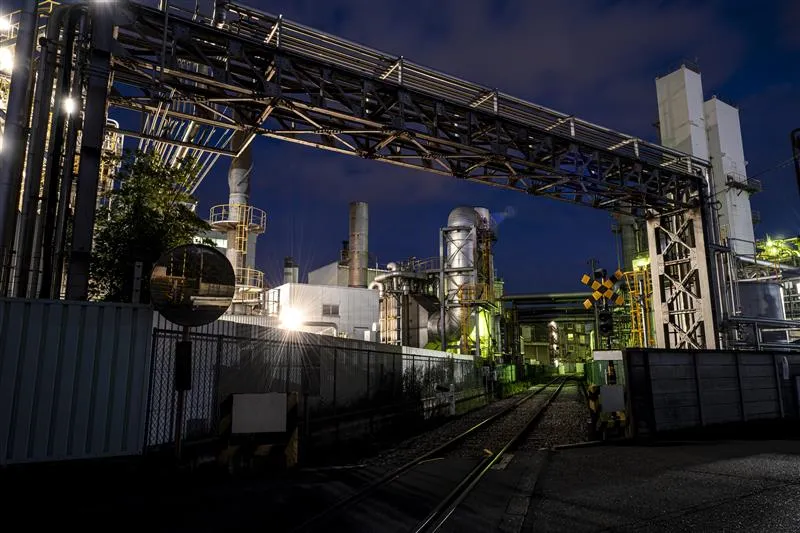
Anonymized feedback 2025: how we deployed DAT’Power on a high-threshold SEVESO site, in controlled phases, to reconcile HSE, cybersecurity, production continuity, and measurable gains.
Introduction
Deploying an energy management system on a high-threshold SEVESO site, without disrupting production and while respecting your HSE and cybersecurity constraints, requires a dedicated methodology.
In this anonymized client case, we detail our client's context (ATEX zones, confined spaces, working at heights, POI/PPI, DREAL/SDIS audits, OT/IT segmentation) and our response. Our expertise: a safe, measurable, and reproducible deployment on your sensitive units.
Context and constraints of a high-threshold SEVESO site
In this 2025 feedback on a high-threshold SEVESO site, we review what our DATIVE energy optimization experts implemented in the Lyon region: metering plan, instrumentation, secure OT/IT integration, DAT’Power dashboards, commissioning, and measured results. The project was conducted in three progressive phases to deliver quickly, reduce risks, and structure the deployment of a complex technical project:
Phase 1 — Operational Foundation: metering plan targeting critical UES, reliable collection, cybersecurity architecture, profile-based dashboards, alerts, and first KPIs (IPE, baseload, €/day)
Phase 2 — Extensions & control: additional points, energy control scenarios (simple loads outside ATEX), advanced reporting, and operating routines
Phase 3 — Predictive & industrialization: DAT’Process (vibrations, Temp, load/no-load), multi-site standardization, governance, and continuous improvement
Regulations and HSE: analysis of our client's obligations and procedures
We started with an HSE-first framework: POI/PPI (Internal Operations Plan / Special Intervention Plan), permits, lockouts, safety induction, and co-activity with planned shutdowns. In practical terms: go/no-go milestones, short intervention windows compatible with production, pre/post-intervention checklists, shared logbook, and ready for audit.
On the ground, we worked with the HSE team and the workshops: daily briefings, controlled purging before connection, repressurization under HSE supervision.
Result: zero incidents, zero unplanned shutdowns, complete traceability.
Contact our experts to structure your project in a sensitive environment
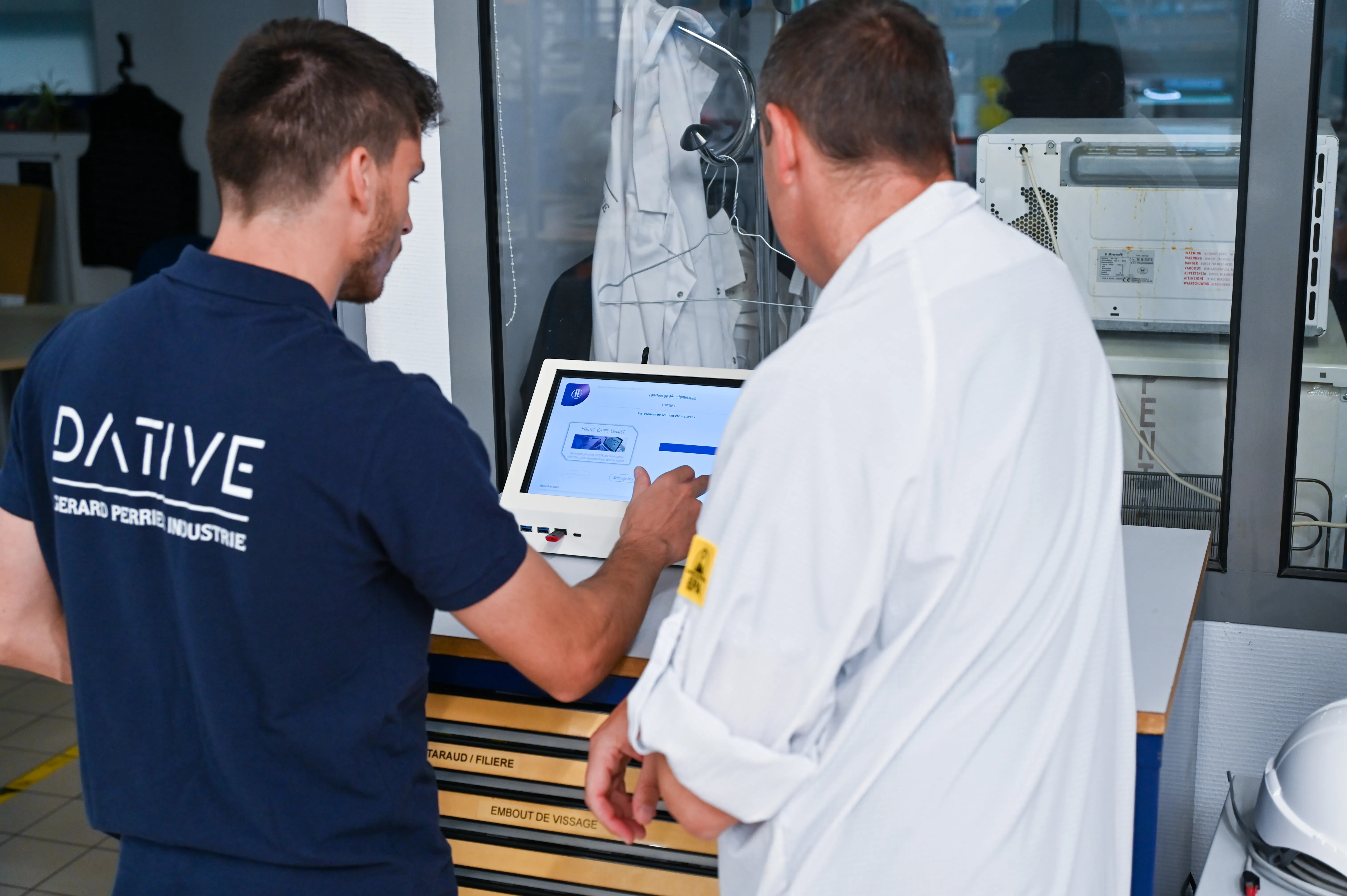
Constraints of deploying meters and sensors in a critical ecosystem
ATEX zones (materials/methods), confined spaces (ventilation, gas detectors, buddy system, PTI), working at heights (lifelines, lifting equipment), hazardous materials management: we selected compatible hardware for each zone, defined installation methods per class, systematically monitored the atmosphere, and marked out each intervention zone.
The installation was practiced "dry" before execution; IP (Ingress Protection rating) / IK (Mechanical impact resistance rating) checks and labeling were documented.
Deliverables: ATEX/height/confined space dossier, post-installation checklist, signed logbook.
Cybersecurity management of the industrial system
Our client's requirements: no gaps in the OT, compliance with IEC 62443 / NIS 2 standards, logging, hardening, MFA for remote access. We deployed technical accounts with minimal privileges, centralized logging, and change review.
Our DATIVE team has a unit fully dedicated to industrial cybersecurity, ensuring each customer receives the appropriate cyber level for their environment and business.
As part of deploying our energy monitoring solution on this SEVESO site, we set up, for remote access, a secure remote maintenance gateway featuring an encrypted tunnel, multi-factor authentication, and centralized session management. The data exchange map (protocols, frequencies, units) was validated with the IT department; traffic tests and a fallback procedure were performed before commissioning.
Deliverables: zones/traffic diagram, signed traffic matrix, logs, cyber commissioning report

Consult our dedicated article on the NIS 2 Directive to learn more about cybersecurity in Europe
Organization and operations (audits, continuity, communication)
We aligned workshop/shift schedules, set go/no-go milestones, worked in micro-windows, and verified return to service. Daily: shared logbook, coordination stand-ups, verification of restart (measurements, sensors, cable routing, protections), weekly summary for the project committee.
Deployment on our client's industrial site: RETEX 2025
Metering plan & targeted instrumentation
We instrumented where it matters: UES electricity / compressed air / gas / heat. Electrical sub-metering (AHU, heat pumps, workshops), gas m³ pulse capture on boilers, thermal energy meters, compressed air flow and pressure.
We use harmonized unit reference systems (kWhelec/Nm³ for air, m³ gas/kWh heat for the boiler room) to ensure reliable and consistent comparisons.
Schedule a meeting with our experts to validate your UES list and metering plan
Supervision/ERP integration and production data
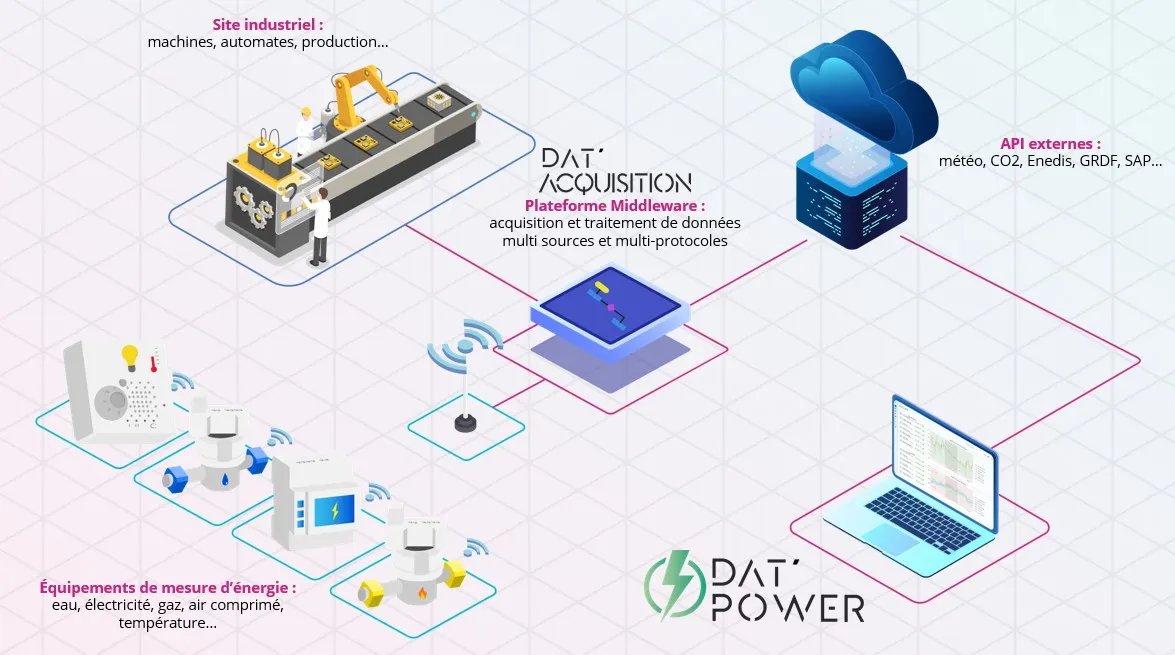
On the IT/OT side, we selected Modbus TCP/IP and OPC UA protocols depending on the perimeters, and set up CSV exports via an ETL when application integration was not required.
This choice allows us to adapt the level of integration according to the needs: Modbus TCP/IP for simplicity and field compatibility, OPC UA for structuring and secure data exchanges, and CSV exports for cases where real-time is not required.
The data exchange map (addresses, units, frequencies) and quality controls (plausibility, interpolation in case of missing data) secured the calculation of IPE.
At DATIVE, we master nearly all industrial communication protocols, allowing multi-brand and multi-protocol integration of your existing equipment.
Industrial energy management dashboards by profile and actionable alerts (DAT’Power)
We configured Management, Energy, and Maintenance views so that each department receives an industrial monitoring interface tailored to its field needs.
Management: consolidated costs and energy trajectory to track site commitments and prioritize efficiency investments.
Energy: energy performance indicators (IPE) per UES, deviations expressed in €/day, and night baseloads to detect invisible losses and adjust setpoints.
Maintenance: automatic alerts, compressor no-load time tracking, and prioritization of interventions to reduce consumption linked to technical deviations.
Standard rule: if the compressed air baseload exceeds X kWh for Y hours, open a ticket and notify the technical team.
We completed this step with a commissioning per UES, user training, and transition to production.
Request a demonstration of our DAT’Power solution, tailored to your profiles and industrial environment.
What concrete results and benefits for this SEVESO industrial site after implementing their energy management solution?
Indicators, quick wins, and compliance
The IPE visibility per UES and €/day alerts allowed for quick handling of deviations and reduction of baseloads identified during nights and weekends. The work was carried out with zero incidents and traceability ready for audit (DREAL/SDIS).
These initial indicators confirm the relevance of the deployment and the robustness of the methodology used.
KPIs tracked: IPE before/after, kWh → €/day → €/month based on tariff periods, rate of relevant alerts, response time.
Example: compressed air baseload detected and corrected, with an immediate decrease in €/day.
Get an estimate of potential gains and ROI for your industrial site.
Timeline and next steps for this high-threshold SEVESO industrial client
Moving from monitoring to energy control of the industrial process
After securing the supervision and analysis phase of its consumption, our client is now preparing for the active energy control of its installations.
The objective is no longer only to measure, but to automatically act on certain equipment to optimize operation in real time.
In the initial phase, scenarios will cover simple loads outside the ATEX zone (lighting, ventilation, pumps) to reduce unnecessary consumption during off-peak hours. These actions will be managed within a change governance framework adapted to the SEVESO context: impact analysis, fallback plan, and validation via acceptance protocol.
A limited pilot will validate the reliability and safety of the system before a gradual scale-up by zones, guaranteeing measurable and controlled gains.
Predictive maintenance with DAT’Process
Following monitoring and energy control, it is possible to go much further in managing the overall industrial process using DAT’Process.
This is specifically a predictive maintenance solution developed by DATIVE. It leverages data from field sensors (vibrations, temperatures, load/no-load states, pressures, electrical consumption) to anticipate mechanical and energy deviations of critical equipment.
As a logical extension of DAT’Power, it goes beyond simple measurement: correlating process and energy signals, predictively detecting abnormal behaviors, and triggering service orders in the CMMS.
The goal: reduce unplanned shutdowns, extend equipment lifespan, and stabilize energy performance indicators (IPE) over time.
DAT’Process can also go further, for example with quality tracking and scrap minimization, capitalising on knowledge, and optimizing collaboration/knowledge sharing...

Conclusion
This project illustrates our ability to operate on sites with high requirements — classified as high-threshold SEVESO — while balancing safety, performance, and innovation.
Thanks to a phased methodology, our teams deployed a robust DAT’Power foundation, progressively expanded energy coverage, and paved the way for intelligent control of the installations.
Beyond monitoring, this approach places data at the center of industrial decision-making: measure, understand, act, and then predict. With DAT’Process, this logic extends into predictive maintenance, to anticipate deviations, improve equipment reliability, and guarantee production continuity.
This project demonstrates that a successful energy transition relies as much on technology as it does on method and supporting field teams.