Compressed air leaks in industry: DATIVE and Les Experts GPI enable you to reduce your energy costs

Thomas Peyron
•
Compressed air leaks incur significant costs and affect operational performance. Discover how DAT’Power detects and alerts in real-time, quantifies losses in €/day, and assists in prioritizing field interventions with Les Experts GPI, up to predictive maintenance with DAT’Process.
Introduction
Compressed air leaks are costly and weaken your industrial processes. With DAT’Power, detect and alert in real-time, quantify losses in €/day, and prioritize interventions. Les Experts GPI resolve the issues on-site, while DAT’Process shifts your operations to predictive maintenance for sustainable gains.
Why track compressed air leaks in industrial environments?
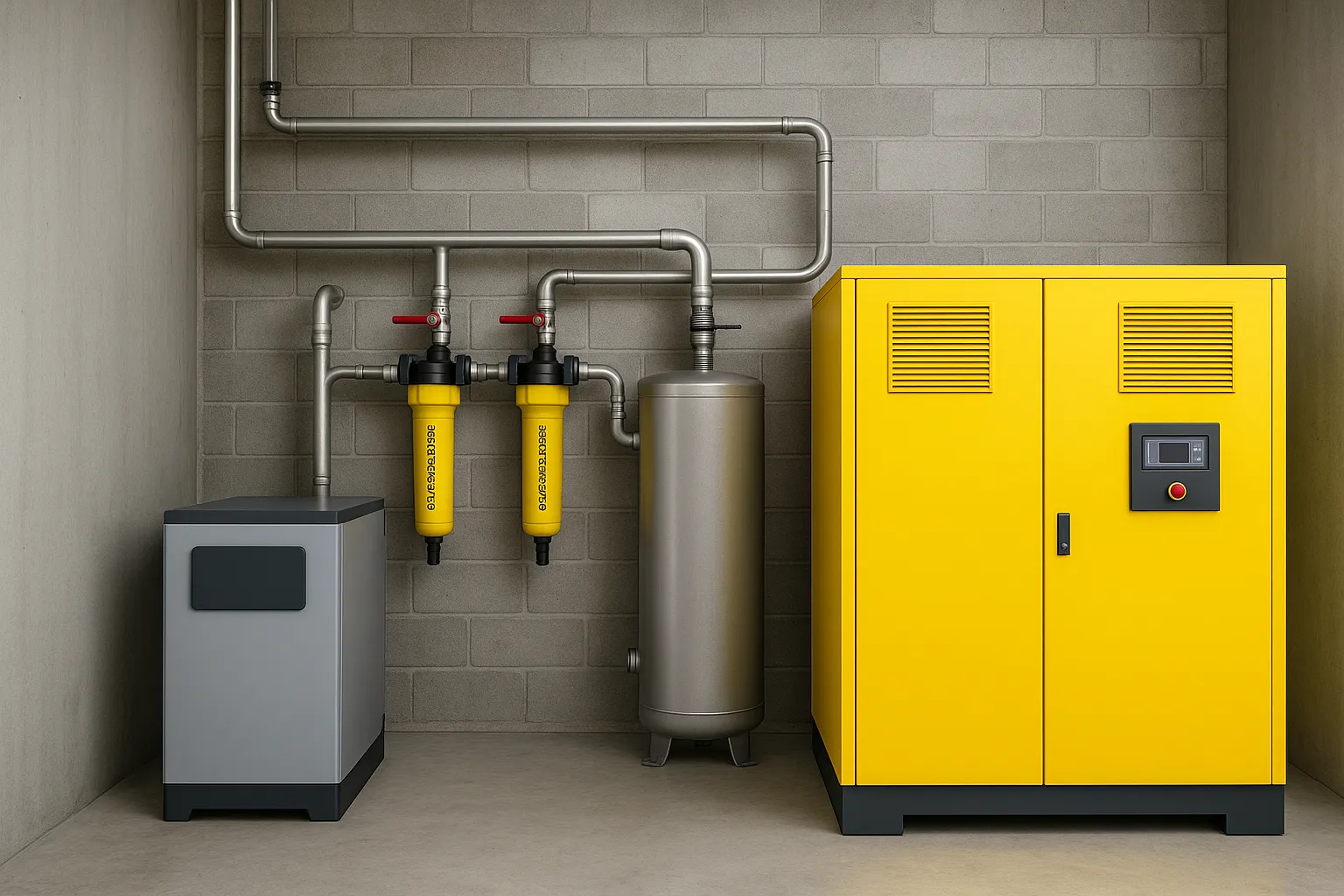
Compressed air leaks directly impact operating costs and destabilize the distribution network:
Pressure drop
Quality deviations in sensitive processes
Accelerated wear on equipment
Furthermore, they mask other, more discrete anomalies. Ultimately, the overall performance of the facility is impacted.
Useful benchmarks: significant financial losses associated with industrial gas and compressed air leaks
On poorly managed networks, losses frequently range between 20% and 30%. With a structured approach, a realistic target is ≤ 10–15%. This variance often self-funds a portion of the corrective actions: depending on the size of the installation and electricity prices, this can quickly represent thousands of euros per month.
Operational impacts: an industrial process slowed down and overconsuming
Unstable pressure penalizes downstream machinery: longer cycle times, rejects on critical lines, and disrupted restarts. Compressors compensate by running longer to maintain base consumption at standstill. This results in overconsumption, overheating, unscheduled maintenance, and reduced availability.
Specifically, what we track:
Overall network leak rate.
Base consumption during night, weekend, and shutdown periods.
Real-time leak alerts during deviations.
This threefold approach provides a clear view of electrical overcosts and process risks, offering a common foundation to prioritize actions.
Field example: at a client's multi-ply paperboard production site, night-time base consumption doubled after a technical shutdown, causing a pressure variation of ± 0.4 bar during restarts. Our leak-detection campaign reduced the leak rate to under 15%, delivering immediate energy savings and restoring process stability.
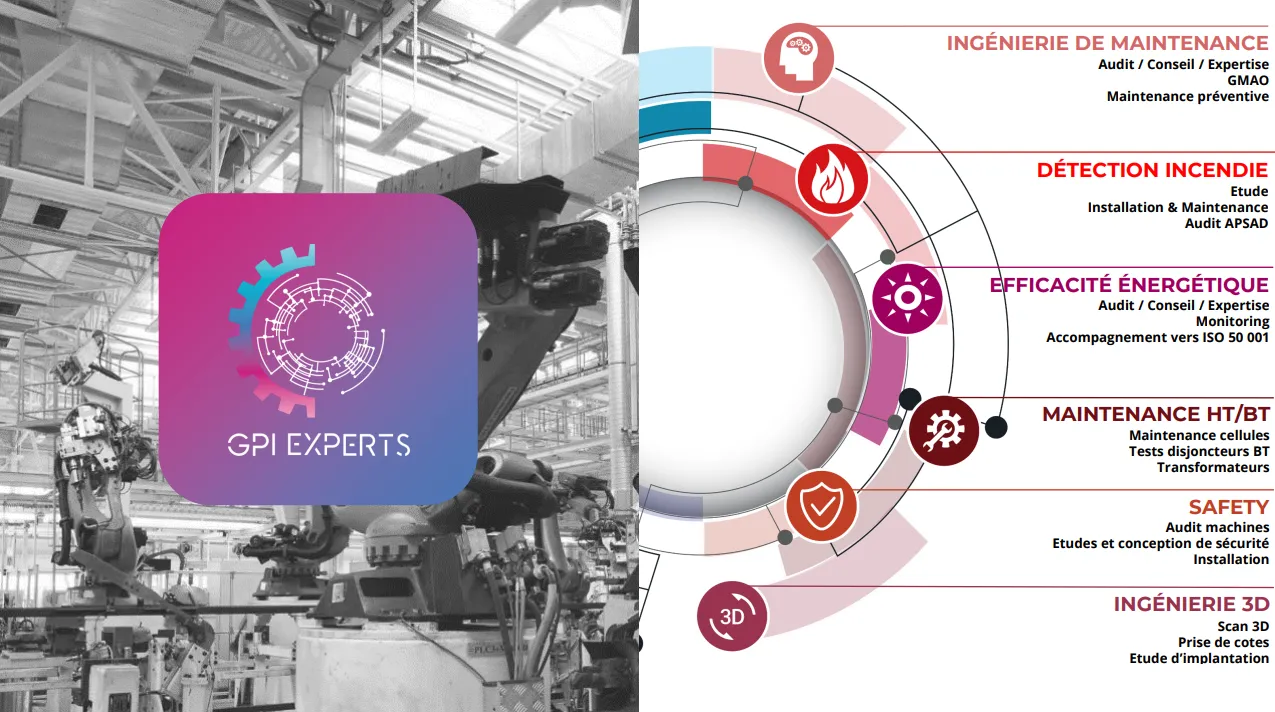
Measuring rapidly, alerting early, and quantifying in €/day allows for quick arbitration of urgent tasks, followed by a targeted campaign with Les Experts GPI: our specialized technicians in compressed air network leak detection and localization, part of Groupe Gerard Perrier Industrie, of which DATIVE is a subsidiary. The entire process is monitored and measured within DAT’Power.
Speak to an expert — arrange an initial on-site evaluation focusing on leak rates and base consumption
Industrial sectors most exposed to compressed air / gas / steam leaks
Paper & cardboard industries (paper mills, corrugated)
Featuring extensive networks, continuous operations, multiple pneumatic control points, and dryers: even minor leaks degrade system pressure and disrupt line speeds. The cost/quality impact is immediate, making precise monitoring of base consumption and real-time alerts critical to preventing deviations during restarts.
Food & beverage sectors
High hygiene and throughput requirements, with numerous valves and fittings subjected to washing / CIP: micro-leaks accumulate, causing compressors to run longer to maintain setpoints. Regular monitoring of critical loops and compressor hours safeguards availability.
Automotive & metallurgy sectors
Pneumatic tooling, robotics, assembly, and handling stations: in dense networks, a few leaking points are sufficient to cause localized pressure drops and process anomalies (part torque quality, cycle rates). Monitoring leak rates by workshop enables targeted corrective campaigns with optimized ROI.

Plastics industry
Varying pressures and flow rates depending on phases (blowing, injection, auxiliaries): leaks increase compressor idle cycles and heat up the network. Monitoring night/weekend base consumption and load/idle profiles quickly highlights structural losses.
Pharmaceutical & cosmetics sector
Highly sensitive to quality and traceability: unstable pressure can impact sterile packaging or critical operations. Threshold alerts and documented proof of gains (€/day) simplify decisions and audits (ISO 50001, sobriety plans).
See also: our reference article on compressed air, ideal for structuring your benchmarks and preparing your actions.
Move from observation to action. To quickly identify savings potential and prioritize your interventions, we offer an express diagnosis conducted by Les Experts Gérard Perrier Industrie: instrumented detection (ultrasound), qualification of leak points, and quantified loss estimation on a sampled scope. You then decide on a complete campaign and follow up on outcomes within DAT’Power.
Request an express diagnosis of your compressed air installation via our contact form
Control your industrial air leaks with our monitoring and automatic alert solution DAT’Power
Calculate and monitor the efficiency of your compressors
The correct indicator for monitoring a compressor is the efficiency in kWh per m³ of air produced. In DAT’Power, you track this IPE over time, compare load and idle periods, spot deviations after restart, and target probable causes: leaks, excessively high pressure setpoint, or dryer faults.
Regarding CEE (Energy Savings Certificates), schemes exist for compressed air, but amounts are often limited for the compressor alone; the main benefit remains continuous energy savings achieved via monitoring.
Monitor your industrial air base consumption and detect anomalies
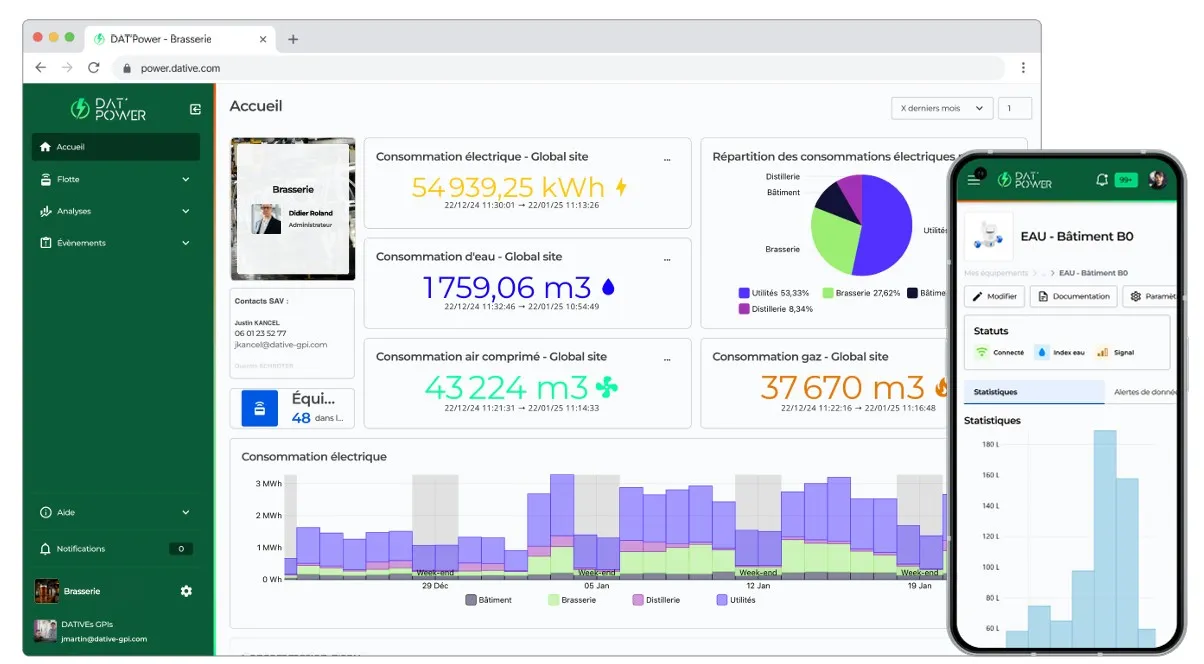
Base consumption is the residual usage when production is stopped, typically at night or during weekends. It is the primary area for optimization because it aggregates losses from leaks and equipment left open. Our Energy Management System DAT’Power displays your base consumption by workshop and time slot, highlighting deviations—such as a weekend base consumption increase following maintenance. Addressing this first reduces consumption rapidly, before refining during production hours.
Configure custom thresholds and real-time alerts
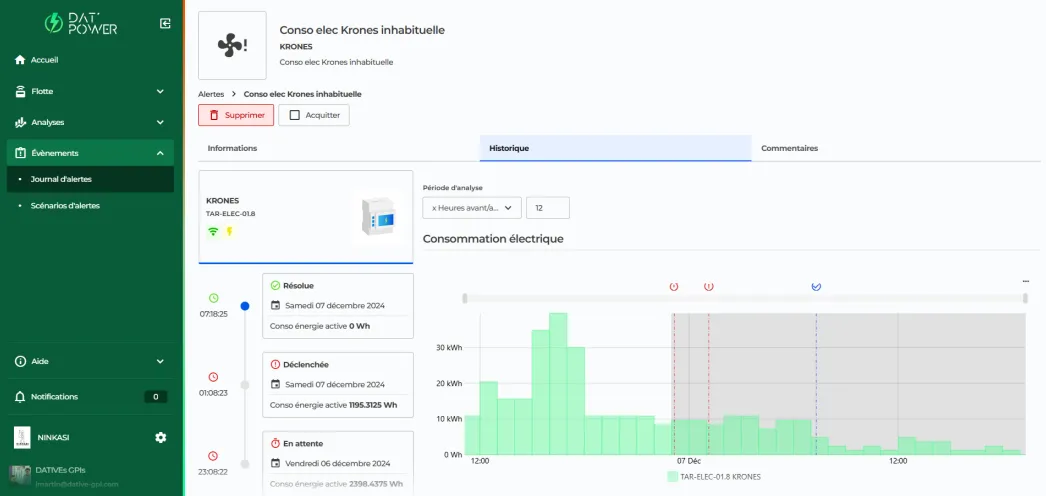
Set static or dynamic thresholds based on operational hours. Alerts are sent through multiple channels, including email and mobile notifications, and are assigned to specific user profiles (maintenance managers, line managers, energy managers, etc.).
Example of a simple rule: if base consumption remains above X kWh for Y hours, notify team Z. If needed, DATIVE energy experts are available to assist in exploiting the data, selecting thresholds, reading trends, and defining action plans.
Measure and quantify losses linked to leaks on your compressed air network
Instrumentation and continuous measurement
We specify auxiliary instrumentation matching your network requirements: energy meters on compressors, flow meters on main outgoing lines, pressure and temperature sensors to qualify load profiles, and sub-metering points per workshop/machine where appropriate. The dual objective is to continuously measure production and usage, and then isolate deviations via non-operational base consumption. Best practices include historical unit reference stability, reliable timestamps, and documenting operational modifications to compare periods under identical conditions.
Contact us to estimate the cost of instrumentation and monitoring for your scope.
Conversion from kWh to €/day: economic valuation of your gains
Within DAT’Power, your electricity tariff is configured. Energy curves are automatically converted into euros per day and per month, with annual projections. This associates operational deviations with costs understandable by all parties: energy, maintenance, and management teams.
Example: a base consumption of twelve kWh per hour represents twenty-eight point eight euros per day at a rate of ten cents per kWh, translating to eight hundred sixty-four euros per month over a thirty-day period. This financial analysis supports decision-making and the prioritization of interventions.
Speak to a DATIVE expert to structure minimal instrumentation, monitor base consumption, and configure euro conversions in DAT’Power.
Arbitrate and prioritize your leak reduction campaigns via maintenance or troubleshooting
ROI calculation relative to losses, potential gains, and campaign cost
In DAT’Power, initiating a campaign relies on a simple triad: leak rate, base consumption, and configured energy cost. The tool converts deviations into €/day, €/month, and annual forecasts, then compares this savings potential with the estimated cost of a detection and repair campaign. With clear ROI, you prioritize workshops where the financial balance is optimal. Process decision example (go/no-go): if the base consumption in Workshop A represents €35/day for an estimated campaign cost of €2,500, the 3-month ROI threshold is quickly met, indicating a go. If Workshop B represents only €8/day for a cost of €3,000, you defer scheduling or consolidate with neighboring actions to improve the ROI.
Verify the impact of your air leak repair campaign using DAT’Power
Before intervention, you lock in a baseline reference period, including nights and weekends. Post-intervention, you compare the periods in DAT’Power, tracking the reduction in base consumption, changes in efficiency (kWh per m³ of air produced), compressor operating hours, and pressure stability. Gains are displayed live in dashboards and consolidated as avoided €/day, securing subsequent optimization decisions.
Take action with Les Experts GPI for industrial air and gas leak detection
Instrumented detection using FLIR Si2 Pro ultrasonic acoustic camera
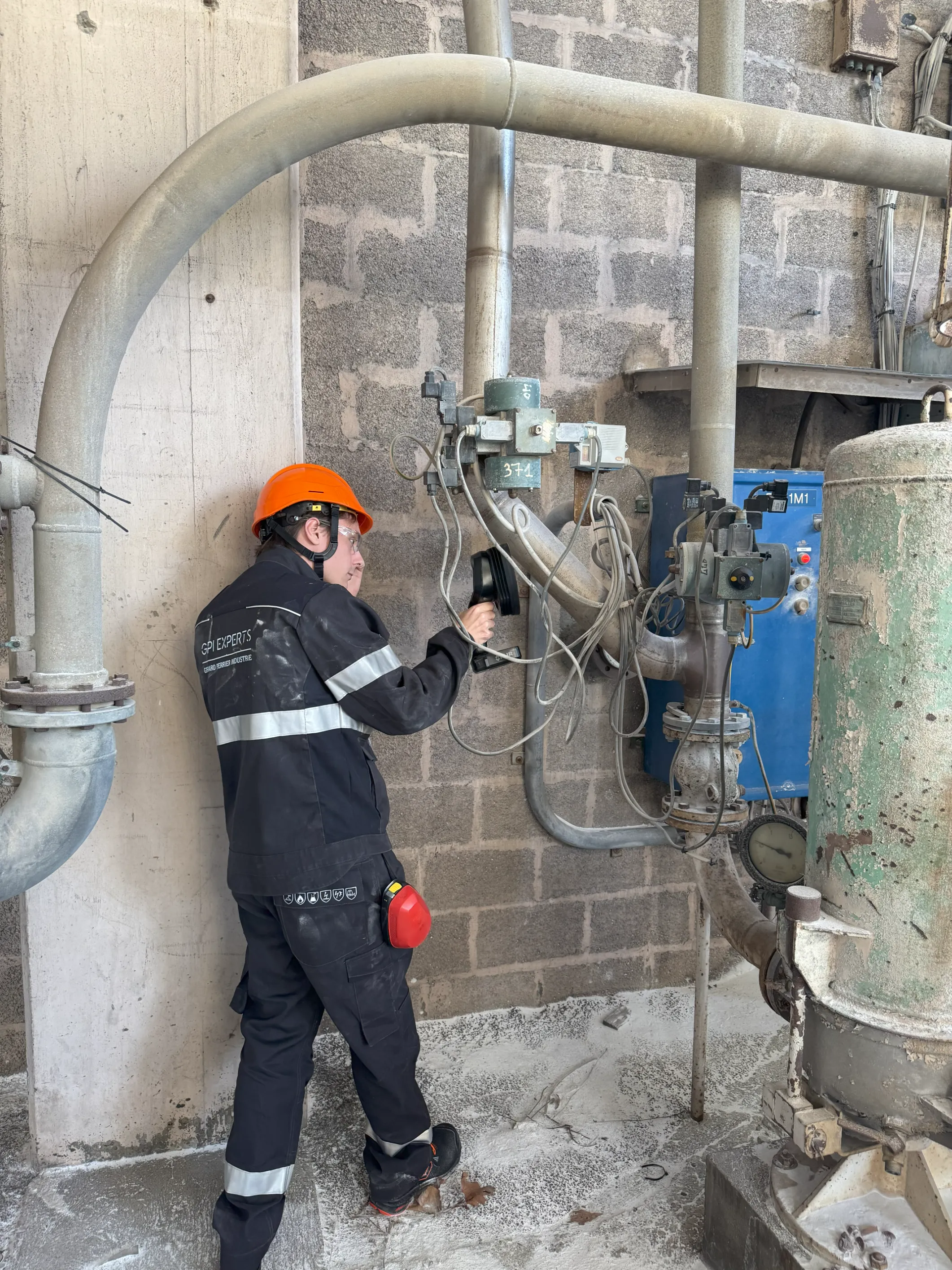
Les Experts GPI operate on your industrial sites with an ultrasonic camera, tracing pipelines and distribution mains to conduct targeted checks and accurately locate each leak. Every leak point is photographed, geolocated within the workshop, qualified, and estimated by volume and corresponding scale in kWh. You receive a structured field report to integrate into your action plan and remediation priorities.
Concrete on-site example: in the preparation area of our paper industry client, three quick-connection leaks and a micro-fissured hose explained the weekend base consumption increase. Rectifying them stabilized system pressure immediately upon restart.
Correction and optimization of the air network
Depending on criticality, your maintenance teams or our partner SOTEB (also a subsidiary of Groupe Gérard Perrier Industrie) perform seal replacements, hose and fitting renewals, and workshop-level pressure adjustments. We then propose a periodic inspection program to maintain the leak rate within the targeted range (less than or equal to 15%) and prevent high base consumption from recurring post-shutdown.
Post-repair verification and improvement loop
Following intervention, a specific DAT’Power dashboard displays the base consumption curve before and after, alongside tracking indicators: compressor efficiency, operating hours, and alerts. This tight closed-loop verifies performance gains and informs your progress plan across sites.
Speak to a DATIVE expert to schedule a leak detection campaign with Les Experts GPI.
Further optimization with DAT’Process and predictive maintenance
Correlating compressor conditions and process signals
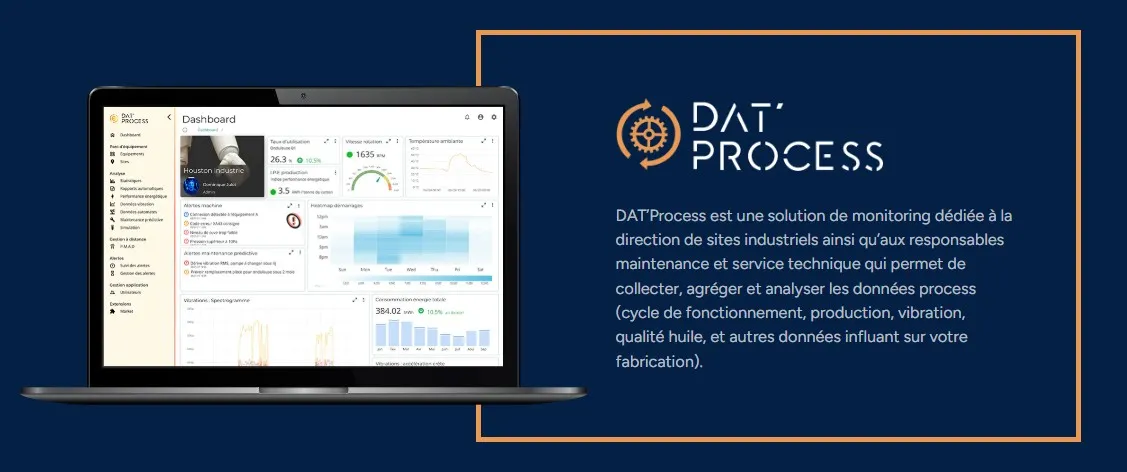
With our industrial monitoring solution DAT’Process, you cross-reference load/idle cycles, vibration, temperature, dryer status, and production data. The objective is simple: detect early-stage deviations signaling impending failure or overconsumption (slipping belts, leaking valves, dryer faults) before they affect operating costs or product quality. This stabilizes both production pressure and efficiency in kWh per cubic meter of air produced, allowing your team to schedule interventions optimally.
Examples of actionable alerts:
gradual increase in bearing vibration levels: schedule physical inspection
abnormal rise in discharge temperature
extending idle cycles: likely leak
excessively high pressure setpoint
Use case: vibration analysis for compressors
A vibration analysis module mounted on the compressors of a wire-braiding client monitors performance signatures and reports deviations. Predictive maintenance triggered by a vibration alert on the main compressor, combined with a slight decline in efficiency (kWh per cubic meter), enabled a timely belt replacement, avoiding both an unscheduled shutdown and a weekend base consumption spike. Discover DAT’Process for your compressors and auxiliaries, featuring multi-signal correlation and predictive alerts.
Expected results and success KPIs
Leak rate converging towards 10% to 15%.
Quantification of avoided losses post-maintenance visible in DAT’Power, validating the solution and maximizing ROI.
Reduced compressor hours, ensuring more stable pressure during production and restarts.
Avoided process incidents, leading to increased line availability.
Full traceability for ISO 50001 and energy reduction plans, via automatic dashboards and periodic reports saving engineering time.
Schedule a meeting with our energy experts to estimate your potential savings, rapidly define your scope, and configure KPIs and reports in DAT’Power.
Conclusion
Mitigating compressed air leaks begins with measurement and prioritization. DAT’Power highlights base consumption, translates losses into euros per day, triggers alerts, and supports intervention targeting. Les Experts GPI secure physical actions through instrumented detection, correction, and post-leak-repair verification. With DAT’Process, you adopt predictive maintenance by detecting early mechanical deviations and stabilizing efficiency (kWh per cubic meter) over time.