Why a LoRaWAN network's performance degrades silently
A LoRaWAN network does not fail abruptly like an Ethernet link. It degrades slowly, without triggering alarms, which is precisely what makes it difficult to operate reliably on an industrial site.
Typical symptoms appear in stages: a device that reports once every two attempts instead of once an hour, frames arriving several minutes late, or a frame counter (FCnt) skipping numbers on the server side. Taken in isolation, each of these signals can go unnoticed. Taken together over a few weeks, they indicate a network that no longer has the necessary margin.
The pitfall is well known: as long as the LoRaWAN server—ChirpStack, The Things Stack, Loriot, or other—continues to receive "something", the intuition is to assume that everything is functioning. In reality, you can lose 30 to 50% of frames without this being obvious in business-level monitoring.
On an industrial site, several factors accelerate this degradation: metallic structures acting as Faraday cages, technical rooms in basements or enclosed in reinforced concrete, machinery generating electromagnetic interference, and long distances between devices and the gateway. The radio channel performs poorly without it being immediately apparent.
Before replacing equipment or restarting a site survey, quantification is required. Four indicators are sufficient.
Explore our energy monitoring expertise with the DAT'Power solution
The 4 key metrics to monitor
RSSI: Received Signal Strength Indicator
The RSSI (Received Signal Strength Indicator) measures the power of the radio signal received by the gateway, expressed in dBm. The closer the value is to zero, the stronger the signal.
A value of -80 dBm is excellent, -120 dBm is marginal, and below -130 dBm decoding becomes unreliable.
The RSSI depends on three main factors: the distance between the device and the gateway, obstacles along the path (concrete, metal, dense forest), and antenna quality at both ends.
When the same packet is received by multiple gateways, the highest RSSI should be analyzed, not the average. The LoRaWAN network server automatically selects the gateway with the optimal reception to relay any downlink transmitting.
SNR: signal quality relative to ambient noise
The SNR (Signal-to-Noise Ratio) measures the difference in dB between the useful signal level and the ambient electromagnetic noise level. On most radio technologies, a negative SNR means communication is impossible. On LoRa, due to chirp spread-spectrum modulation, decoding remains possible down to -20 dB.
This does not mean a -15 dB SNR is comfortable: it represents the physical limit of the modulation. For stable industrial operation, a positive or weakly negative SNR (up to approximately -7 dB) remains the standard target.
The SNR degrades as ambient noise increases: other radio networks in the same band, harmonics generated by motors or VFDs, poorly shielded industrial equipment. An SNR that degrades without a change in RSSI is almost always a sign of new interference in the environment.
Message loss rate
This is the most representative operational indicator. In LoRaWAN, two mechanisms can trigger a retransmission:
On a confirmed uplink (Class A, Confirmed Up), if the device does not receive an acknowledgment from the gateway within the expected window, it retransmits.
On the server side, missing frames can be detected by monitoring the FCnt counter: a jump from 15 to 18 indicates that frames 16 and 17 were lost.
A device with high retransmission rates consumes its battery two to five times faster than expected. For a sensor designed to last five years on a lithium battery, this means a field maintenance intervention after just one year. The ratio "received frames / theoretically transmitted frames" is the most useful synthetic indicator. It integrates all preceding factors and directly establishes the operational health of the link.
Under ADR, a device can choose voluntarily to lower its Spreading Factor (e.g., switching from SF8 to SF7) and transmit the same frame multiple times. Why? Because SF7 has a transmission time twice as short as SF8, resulting in half the energy consumption per frame. Sending 3 frames at SF7 can thus consume less energy than sending 2 frames at SF8, while providing a higher probability of reception.
Gateway redundancy
This is the most critical infrastructure metric, yet it receives the least attention. How many gateways, on average, receive each packet transmitted by a given end-device?
A single gateway: No fault tolerance. If the gateway reboots, loses backhaul connectivity, or fails, the end-device is cut off from the network server.
Two gateways: Minimum threshold for industrial operations. If one fails, the other maintains connectivity.
Three or more gateways: Robust architecture, recommended for SEVESO sites or critical applications.
Redundancy is easily measured on the LoRaWAN network server side: for each uplink, the server logs the list of receiving gateways. A seven-day moving average is sufficient to provide an objective assessment of infrastructure status.
"A successful IoT deployment does not aim for maximum range, but rather maximum reliability. It is better to install an additional, well-positioned gateway than to have a network that drops connection during a storm or when industrial machinery starts up."
Reference thresholds table
The values below are calibrated for industrial use. They differ slightly from the thresholds used in agricultural or urban settings, where range and interference constraints are of a different nature.
RSSI (best gateway)
-100 dBm
RSSI
Excellent
-100 to
-115 dBm
RSSI
Acceptable
-115 to
-125 dBm
RSSI
Degra d e d
< -125 dBm
RSSI
To be processed
SNR
> 0 dB
SNR
Excellent
-7 to 0 dB
SNR
Acceptable
-10 to -7 dB
SNR
Degra d e d
< -10 dB
SNR
To be processed
Message loss rate
< 5%
Message loss rate
Excellent
5% to 15%
Message loss rate
Acceptable
15 to 30%
Message loss rate
Degra d e d
> 30%
Message loss rate
To be processed
Gateway redundancy (average)
≥ 3
Gateway redundancy
Excellent
2
Gateway redundancy
Acceptable
1
Gateway redundancy
Degra d e d
0
Gateway redundancy
To be processed
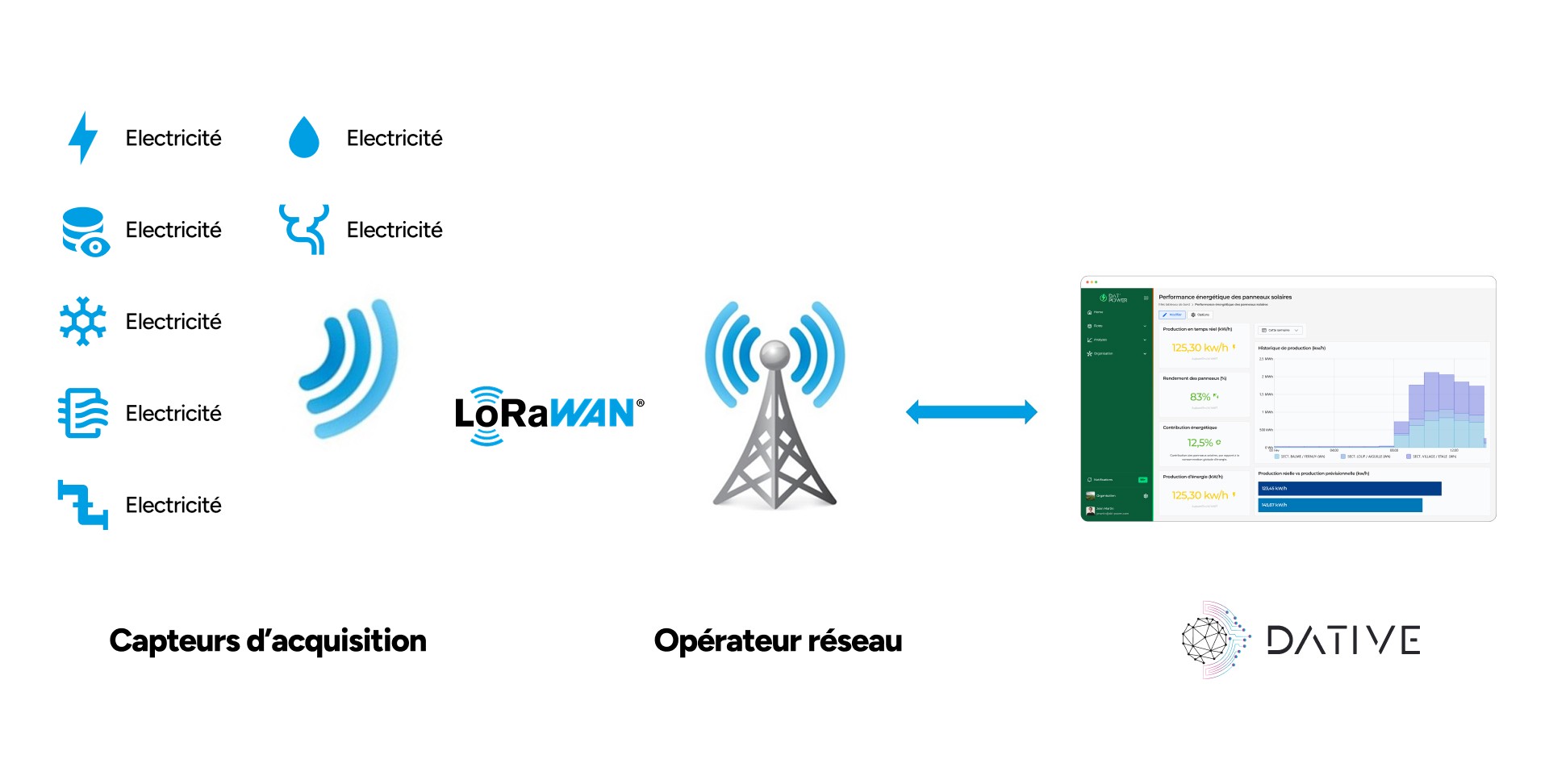
Technical overview of our ski resort management solution, DAT'Mountain
What to do in case of degradation: intervention checklist
The sequence of steps is organized from the simplest and fastest to implement to the most demanding in terms of cost and onsite installation.
1. Verify the equipment battery
A sensor approaching its end of life exhibits weaker and less stable emissions. This is the most common cause of localized degradation.
2. Verify the equipment configuration
Transmission interval, LoRaWAN class, ADR parameters, firmware version. An outdated firmware can introduce aberrant behavior after a server-side change.
3. Conduct a targeted site survey
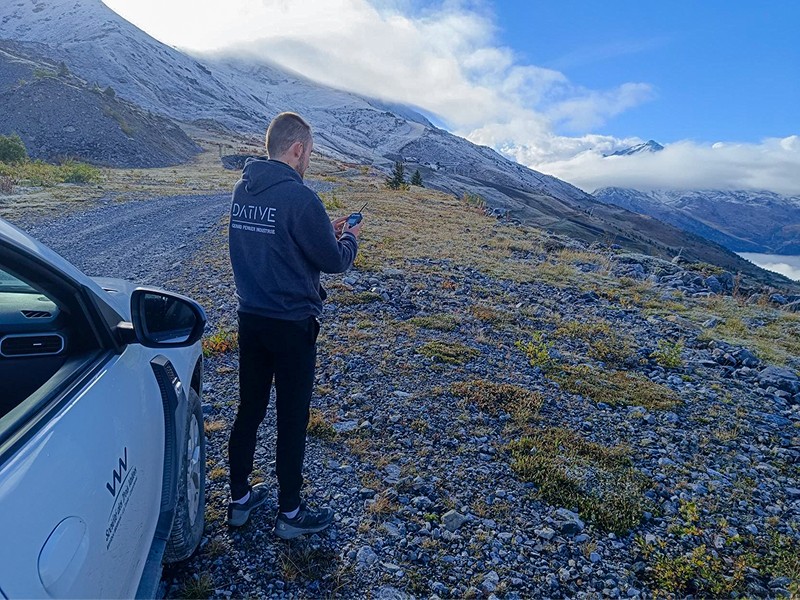
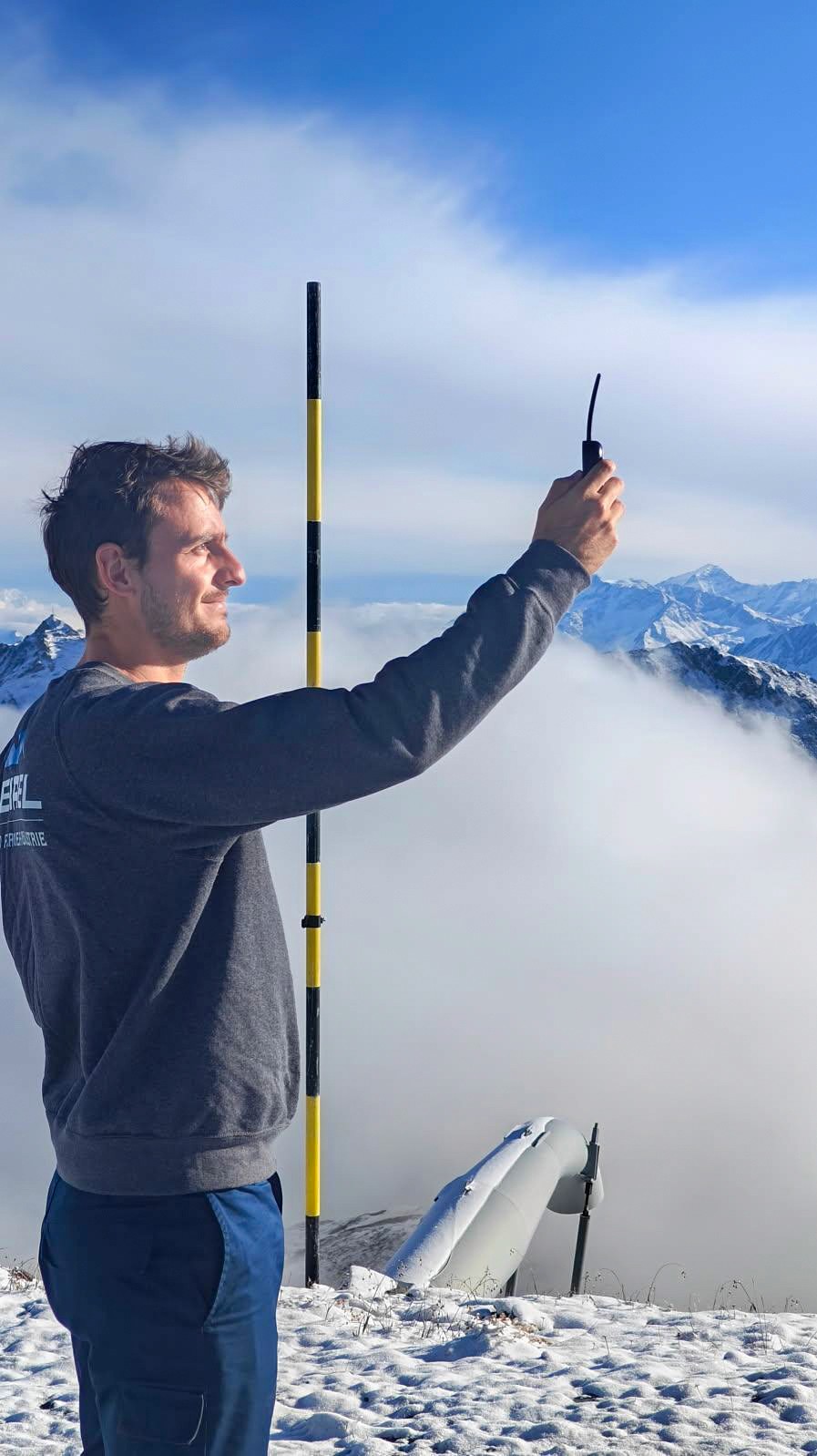
A test device (such as a LoRa Field Tester) allows for mapping the link quality from the sensor location. Essential before any physical deployment.
4. Reposition or requalify the gateway antenna
An antenna that is poorly aligned, obstructed by a subsequently added obstacle, or simply dirty, loses several dB of signal.
5. Add a gateway
If the area is covered by a single gateway, adding another is likely the most effective measure. The cost of an additional gateway is marginal compared to the cost of recurring field interventions.
6. As a last resort, reposition the equipment or install a remote antenna if the device is compatible.
Note that adding cable length to extend the antenna reduces signal strength.
How DATIVE integrates this measurement into its deployments
On DAT'Power and DAT'Mountain deployments, the LoRaWAN link quality is monitored continuously, in the same way as operational data.
Three indicators (best RSSI, SNR, gateway redundancy) are reported in the supervision system and trigger alerts when a device falls below the reference thresholds for a prolonged window.
The initial audit systematically includes a radio feasibility study. On an industrial site, this involves mapping coverage areas and sizing the number of gateways before ordering equipment. The objective is not maximum range, but the minimum tolerable margin—typically a 10 to 15 dB margin on the nominal RSSI to absorb seasonal variations and site developments.
On ski areas (DAT'Mountain), the constraints differ: range takes priority, and climatic conditions (snow, frost, fog) introduce additional attenuation that must be integrated into the link budget. On dense industrial sites (DAT'Power), penetration into metallic structures and underground technical rooms becomes the limiting factor.

The quality of a LoRaWAN network is not audited once and for all: it must be measured continuously using four simple indicators and thresholds calibrated for industrial use. Deviations are silent but quantifiable, and they always provide warning before an actual outage.
Are you experiencing these technical challenges at your facilities?
Our teams assist industrial operators in the deployment and monitoring of robust LoRaWAN networks.