Industrial HVAC Energy Management: Feedback from the Field with DAT’Power

Baptiste
•
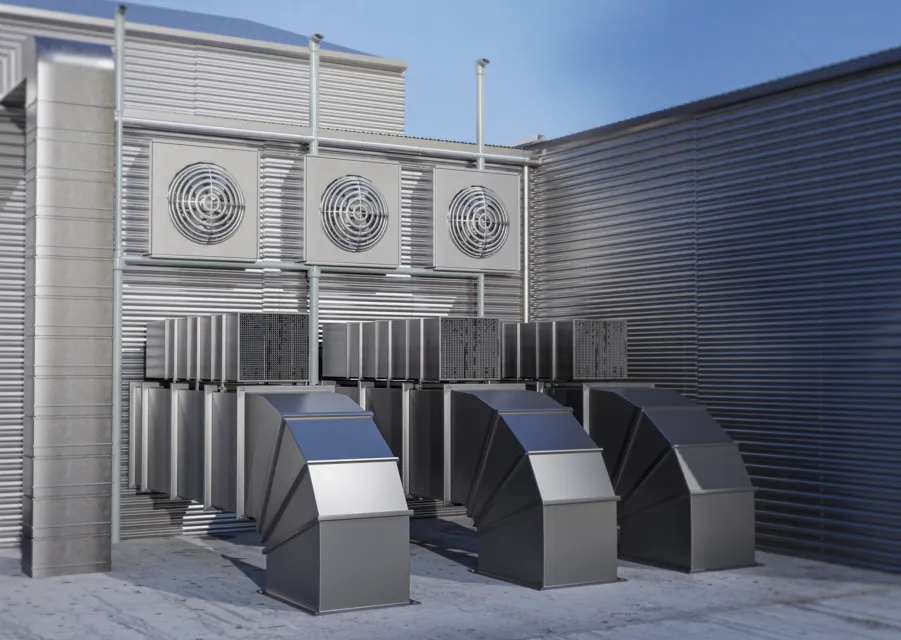
An industrial air treatment systems manufacturer has selected DAT’Power to structure its energy management: multi-UES instrumentation, centralized hypervision, and role-specific dashboards. Discover how this project improves responsiveness and reliability in decision-making for energy and maintenance managers.
Focus on the context and needs of our client, an industrial HVAC manufacturer
Our client, who wishes to remain anonymous for confidentiality reasons, is a manufacturer of industrial air treatment, heating, and air conditioning systems. Their extensive, multi-shift production facility comprises several TGBT (main low-voltage switchboards), dispersed utilities, and numerous Significant Energy Uses (UES) to monitor, from centralized compressed air, boilers, and PAC (heat pumps) to numerous air handling units (CEE/CTA) and product testing zones.
The expressed requirements were clear:
Manage energy at the site level and consolidate consumption into a standardized view.
Detect drift quickly, using reliable and clear indicators.
Adapt dashboards to different user profiles: management (costs and targets), energy (IPE, drift, €/day), and maintenance (alerts, statuses, and prioritization).
Prepare the integration of energy data with the existing factory supervision system and, in the longer term, with the ERP to strengthen global operations.
The electrical networks span multiple buildings, compressed air is produced centrally, boilers and PAC provide thermal comfort, while a large number of CEE/CTA and test zones require constant monitoring quality. These constraints called for a single, robust solution to centralize all information.
If you also face specific constraints where centralizing your data is a major challenge, contact our experts to learn how DATIVE can assist you in scoping and implementing a custom energy management system.
Proposed solution: DAT’Power for hypervision and energy management at this ventilation equipment manufacturer
Technical visit and design of the metering plan
We began with a site visit conducted by our energy management experts. We mapped out the UES and their sub-feeders, then selected high-value measurement points:
Electricity: sub-metering by workshop and CEE/CTA, monitoring active power and active energy at a minimum.
Compressed air: air production and compressor power consumption to monitor efficiency in kWh per Nm³ and base load.
Gas and heat: pulse readings in m³ of gas from existing boiler meters and thermal energy metering to correlate m³ of gas consumed with kWh of heat produced.
compressed air: kWh electricity per Nm³
boiler: m³ gas per kWh heat
other UES
: kWh electricity per production unit where relevant
CEE premium financing study and budget validation
We verified the eligibility of the project for the CEE financing scheme (Energy Savings Certificate), specifically datasheet IND-UT-134, where monitoring supports a management system that drives efficiency gains. We systematically remind clients of the prior-action principle: the CEE amendment must be signed before any work orders are placed.
Together with our CEE partners, we estimate the scale of financial aid and can quickly provide a binding offer integrating this funding.
Deliverable provided: a CEE financial aid estimation report detailing assumptions, eligible scope, calculations, and the next administrative steps to secure the budget.
Contact our team to get a precise estimate of the eligible CEE amount for your energy monitoring project and secure your budget.
A trusted partner for implementation: SOTEB and the strength of the GPI Group
For instrumentation, electrical work, and automation, we primarily rely on SOTEB, a subsidiary of the Gérard Perrier Industrie Group. The Group's teams operate across diverse environments, including manufacturing, agrifood, and sensitive sites such as nuclear plants, and can deploy solutions across multi-site networks with uniform execution standards.
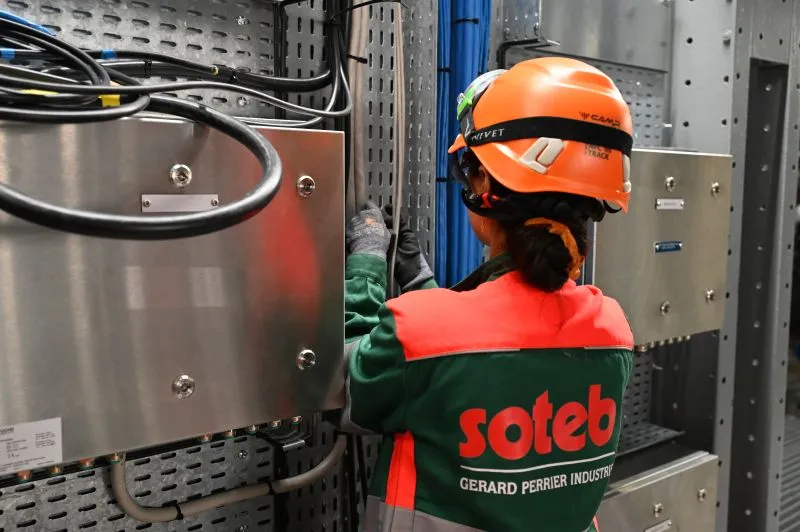
Deployment of the DAT’Power industrial energy management project
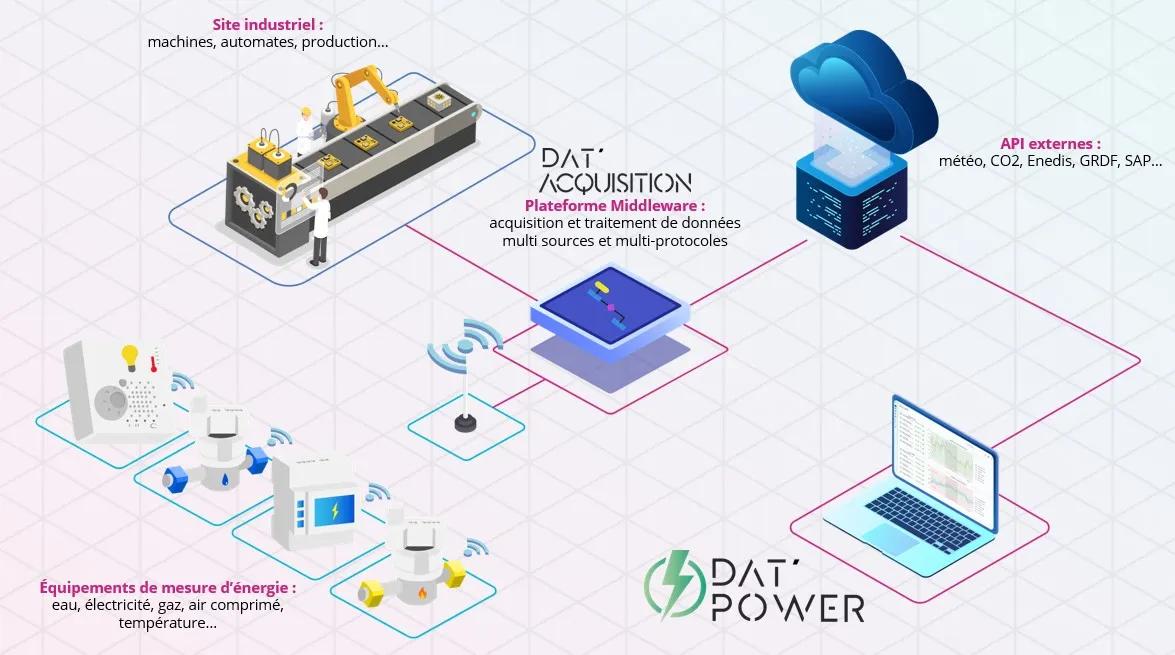
Instrumentation and data ingestion of utility and energy consumption
Compressed air: we measure production using a flow meter suited to the pipe diameter and installation conditions, alongside compressor electricity consumption. You monitor efficiency in kWh per Nm³ and the base load to quantify leaks. Key criteria for hardware selection: available straight length, flow range, temperature, pressure, target accuracy, maintenance, and ease of calibration.
Electricity for UES, CEE/CTA, and PAC: we implement sub-metering by workshop, line, or air handling unit. At a minimum, we retrieve active power and active energy to provide stable indicators, including during transient phases. Depending on requirements, we can add voltage, current, power factor, and harmonics to refine drift diagnostics.
Gas and heat: we capture the m³ gas pulse from existing boiler meters, and install thermal energy meters on the hot water network. This correlates m³ of gas to kWh of heat to feed IPEs and efficiency reports.
IoT network: we deploy a private LoRaWAN network to secure data collection across large sites, hard-to-reach areas, and environments with strict cybersecurity constraints. This architecture is proven in mountainous areas, nuclear facilities, and manufacturing industries, offering high resilience and local gateways ensuring service continuity.
To identify or validate your list of UES and target instrumentation points on your site, contact our experts to schedule a technical site visit.
Integration with factory supervision and production data
We integrate with factory supervision via a standard protocol, such as Modbus TCP/IP, using a clear exchange table detailing addresses, units, and frequencies. Production data is retrieved via scheduled files or streams to calculate kWh IPEs per production unit (e.g., m² treated, units manufactured, uptime).
Examples:
Mapping the DAT’Acquisition server (data acquisition and centralization server) on the factory side as a supervision client for local access.
Automated CSV upload to a secure folder, controlled ingestion, timestamping, quality checks, followed by IPE calculations.
Custom setup of industrial hypervision dashboards
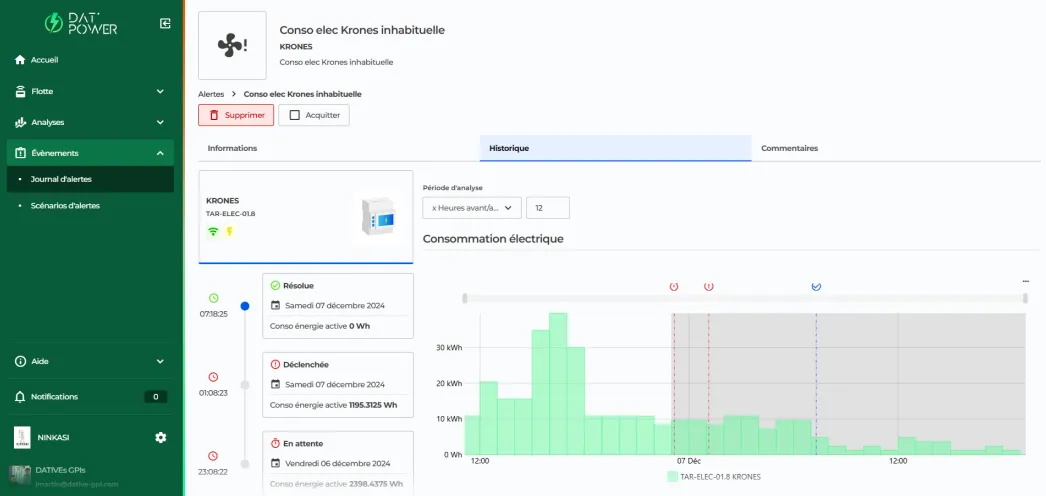
We configure dashboards by user role in our DAT’Power solution to ensure everyone has access to relevant and actionable insights.
Management: targets, consolidated costs, site-by-site trajectories.
Energy management: IPEs per UES, drift, cost per day, action priorities, action plan tracking.
Maintenance teams: alerts, statuses, prioritized tasks list, base loads, and anomalies.
UAT and user training
We perform a functional user acceptance test (UAT) for each UES, verifying measurements, calculations, and alerts. We train site managers, energy managers, and maintenance teams, then review the workflows for alerts, drift, base loads, and escalations.
Example rule: If the base load exceeds X kWh for Y hours on the compressed air UES, notify the maintenance team, open a ticket, and track resolution on the action plan.
Monitored metrics: coverage rate of measured points on critical UES, alert SLAs defined by process impact, and completion rate of actions within the target resolution time.
Expected results and benefits for this air treatment system manufacturer
With DAT’Power, the site now benefits from visibility by UES (CEE/CTA, PAC, compressed air, boilers) and standardized indicators to manage consumption.
Reduction in consumption per UES: Direct visibility of IPEs and drift allows teams to quickly correct anomalies and stabilize consumption.
Increased responsiveness: Dynamic alerts allow corrections to be made during the shift rather than at the end of the month, reducing utility bills and preventing process issues.
Process stabilization: Continuously monitored CEE/CTAs and PACs show fewer variations, maintaining stable conditions in the testing zones.
Traceability: Consolidated data supports efficiency plans and internal audits, and serves as a CEE prerequisite if eligible actions are taken (datasheet IND-UT-134, subject to scope verification).
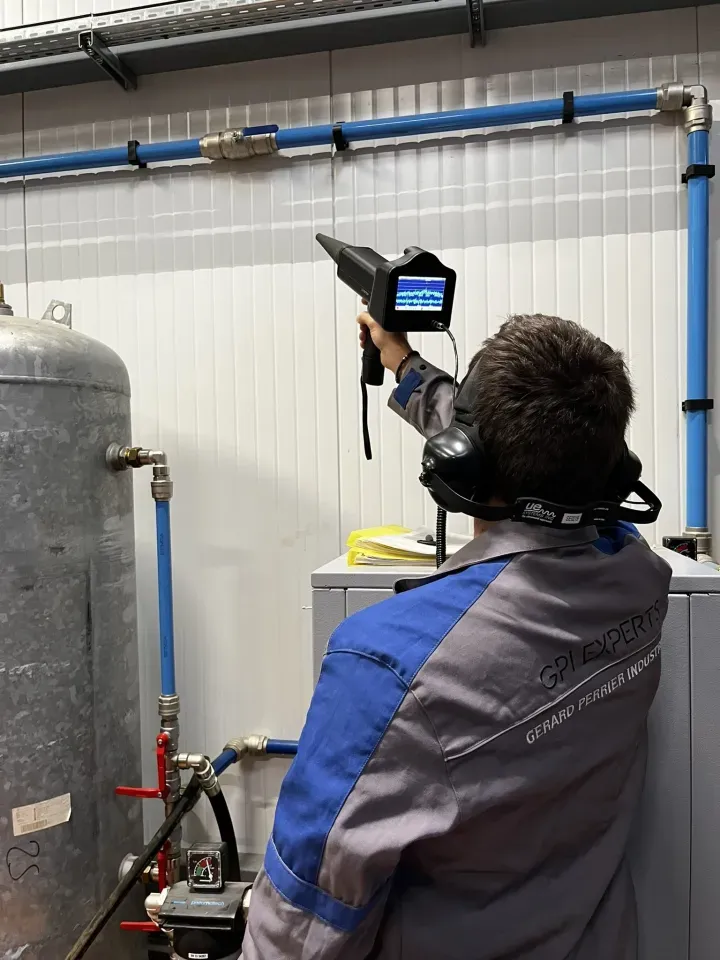
Concrete example: In the utility workshop, an abnormal base load on compressed air was flagged by DAT’Power. Following correction, the base load decreased by more than 15%, immediately improving overall compressor efficiency.
Consult our guide on optimizing industrial compressed air.
Monitored metrics:
IPE per UES (kWh per production unit or Nm³)
Financial savings (euros per day) avoided post-action
Leakage rate reduced below the target threshold
You can contact our energy experts to obtain an estimate of your savings and ROI based on an initial assessment of your scope.
To go further: The benefits of IIoT for industrial energy management
Future developments and next steps for our client
Remote lighting control: DAT’Power GTB/GTC
DAT’Power is not limited to energy monitoring. Utilizing its LoRaWAN dry contact capabilities, it also enables remote control of simple loads, such as lighting. Scenarios can be based on schedules, motion detection, or occupancy status.
The HVAC site is already preparing to integrate this module, transforming DAT’Power into an adaptable GTB/GTC solution rather than just a monitoring platform.
We have published a dedicated article for industrial sites subject to the BACS Decree showing how they can achieve compliance using DAT’Power.
Evolving toward predictive maintenance with DAT’Process
Moving beyond periodic or preventive maintenance, predictive maintenance aims to detect the weak signals that precede failures or drift. With our DAT’Process industrial monitoring solution, you correlate load/unload cycles, temperatures, and vibration analysis to anticipate drift on your compressors, CEE/CTAs, and PACs.
Use case: A vibration drift detected on a compressor, coupled with an increase in unload time, allowed a belt replacement to be scheduled before failure occurred, avoiding production downtime and additional energy costs.
Contact us to discover DAT’Process and integrate predictive maintenance into your energy and maintenance strategy.
Conclusion
With DAT’Power, our client specializing in HVAC manufacturing now monitors its consumption by UES, visualizes drift in real time, and responds faster to alerts. The results include quantified savings, improved stability across CEE/CTAs, PACs, and test zones, and full traceability for audits and efficiency programs.
The next phase involves extending the measurement scope, controlling specific equipment (such as lighting) via LoRaWAN dry contacts, and scaling up to the DAT’Process platform to anticipate mechanical and thermal drift. The company has thus equipped itself with a sustainable energy management system designed for management, energy, and maintenance teams alike.