Industrial HVAC Energy Management: Feedback from the Field with DAT’Power

Quentin Schroter
•
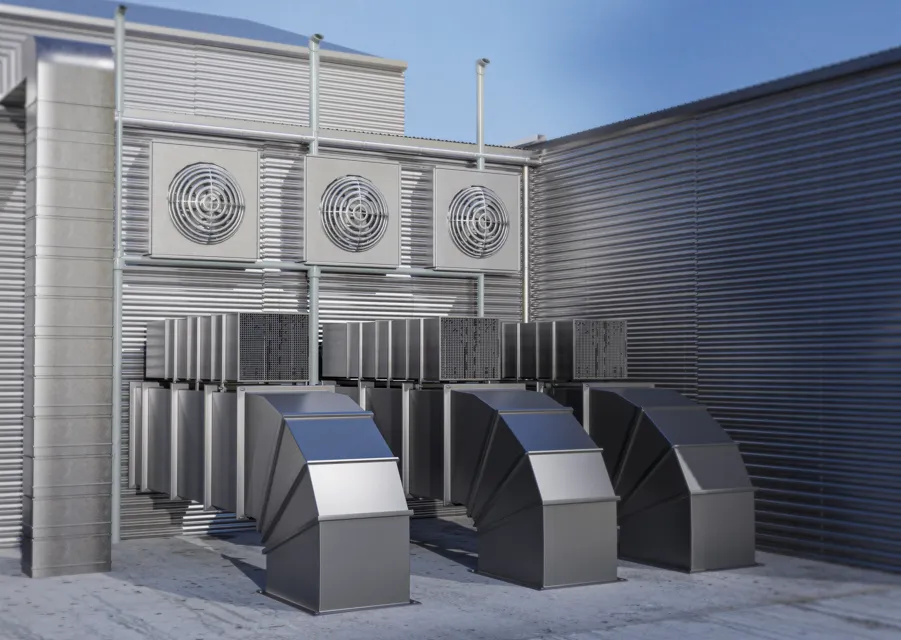
An industrial air treatment systems manufacturer selected DAT’Power to structure its energy management: multi-UES instrumentation, centralized hypervision, and role-specific dashboards. Learn how this project improves responsiveness and secures decision-making for energy and maintenance managers.
Industrial HVAC Manufacturer: Client Context and Technical Requirements
Our client, an industrial air treatment, heating, and air conditioning systems manufacturer, prefers to remain anonymous for confidentiality reasons. The large, multi-shift production facility includes several TGBT (main low-voltage switchboards), dispersed utilities, and numerous Unités Énergétiques Significatives (UES) to monitor, spanning centralized compressed air, boilers, heat pumps, air handling units (CEE), and product testing zones.
The defined requirements were:
Manage energy at the site level and consolidate consumption data into a uniform view.
Detect drift rapidly using robust and reliable indicators.
Tailor dashboards to different user profiles: management (costs and objectives), energy management (IPE, drift, €/day), and maintenance (alerts, statuses, and prioritization).
Prepare energy data integration with the existing factory supervision system and, long-term, with the ERP to strengthen overall operations.
The electrical networks span multiple buildings, compressed air is produced centrally, boilers and heat pumps manage thermal comfort, while numerous CEE units and test zones require constant monitoring quality. These constraints required a single, robust platform to consolidate all data streams.
If you face similar technical constraints and require centralized data management, contact our engineering experts to discuss your requirements and how DATIVE implements tailored energy management systems.
Implemented Solution: DAT’Power for Hypervision and Energy Management
Site Audit and Metering Plan Design
The project initiated with a site audit conducted by our energy management engineers to map the UES and their sub-feeders, selecting critical measurement points:
Electricity: Sub-metering per workshop and per CEE, measuring active power and active energy at a minimum.
Compressed Air: Air production and compressor electrical consumption to monitor efficiency (kWh per Nm³) and baseload.
Gas and Heat: Integration of m³ gas pulse outputs from existing boilers and thermal energy metering to correlate gas volume consumption with generated heat (kWh).
Compressed Air: kWh elec per Nm³
Boiler: m³ gas per kWh thermal
Other UES: kWh elec per production unit where applicable
CEE Funding Analysis and Budget Validation
We assessed the project's eligibility for CEE funding (Energy Savings Certificates), specifically targeting sheet IND-UT-134 for structured monitoring systems that drive efficiency gains. We note that the CEE agreement must be signed prior to placing any orders for works.
In coordination with our CEE partners, we estimate funding amounts and provide structured offers integrating these incentives.
Deliverable: A CEE subsidy estimation report detailing assumptions, eligible scope, calculations, and the administrative steps required to secure funding.
Contact our team to obtain a technical assessment of the CEE funding eligibility for your energy monitoring project.
Installation Partner: SOTEB and the GPI Group
For instrumentation, electrical work, and industrial automation, we partner with SOTEB, a subsidiary of Gérard Perrier Industrie Group. Their teams operate across diverse environments (manufacturing, food processing, and nuclear facilities), delivering multi-site deployments with standardized technical execution.
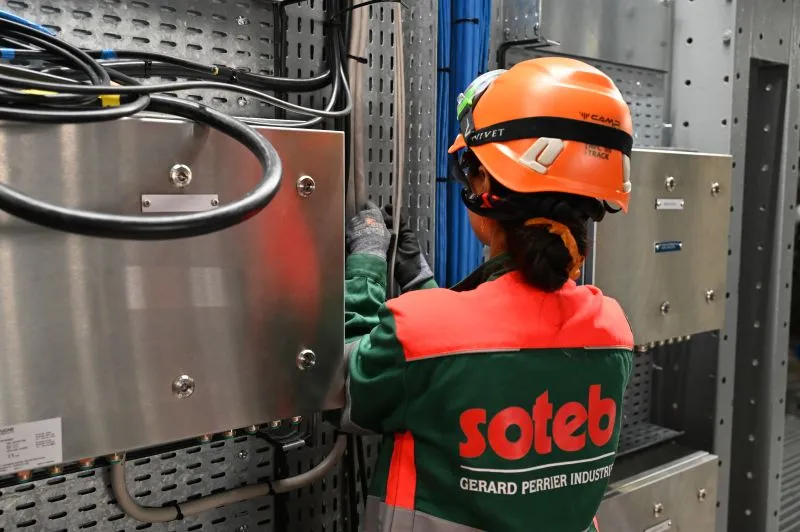
Deployment of the DAT’Power Industrial Energy Management Project
Utility and Energy Consumption Instrumentation
Compressed Air: We measure production with flow meters selected based on pipe diameter and installation conditions, correlating this with compressor electrical power. This tracks efficiency in kWh per Nm³ and the baseload to quantify leaks. Technical criteria include straight run lengths, flow range, temperature, pressure, target accuracy, maintenance access, and calibration requirements.
Electricity for UES, CEE, and Heat Pumps: We install sub-metering at workshop, line, or air handling unit levels. At a minimum, active power and active energy are captured to establish baseline indicators. Depending on requirements, parameters such as voltage, current, power factor, and harmonics are monitored to refine diagnostic capabilities.
Gas and Heat: m³ gas pulse outputs are integrated from existing boiler meters, and thermal energy meters are installed on the hot water network. This correlates m³ gas to kWh thermal, serving as input data for the IPE and efficiency reporting.
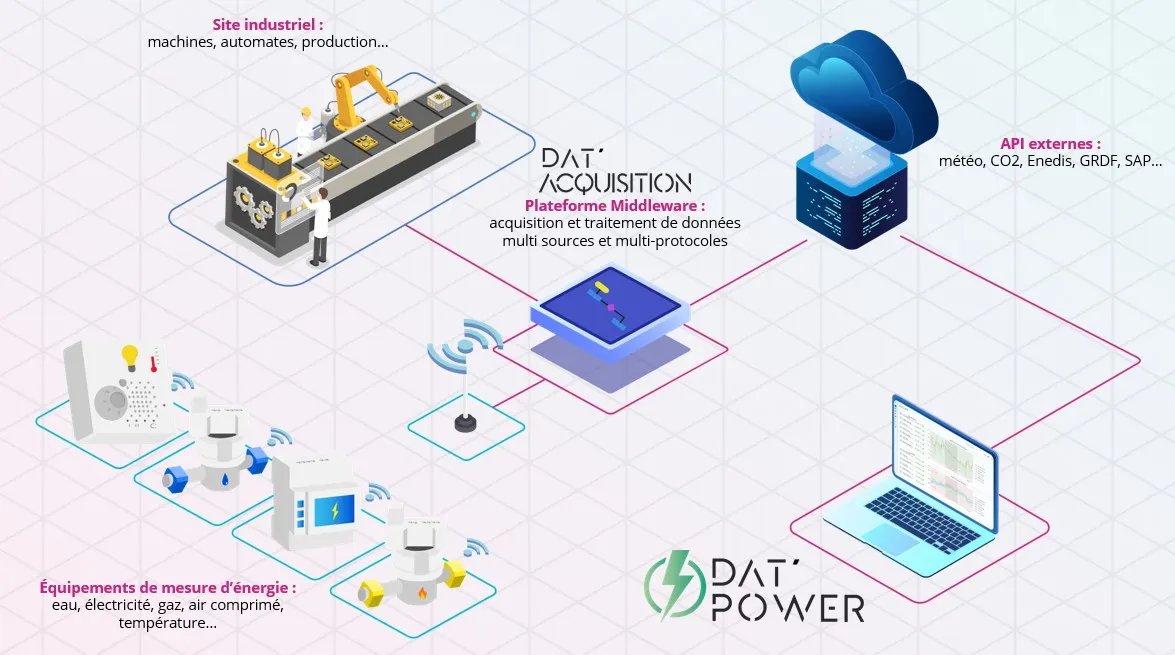
IoT Network: We deploy a private LoRaWAN network to ensure reliable data acquisition across large sites, difficult-to-access zones, and environments with strict cybersecurity requirements. This architecture operates reliably in challenging terrain, nuclear facilities, and manufacturing plants, utilizing local gateways to ensure service continuity.
To define or validate your list of UES and target measurement points, contact our technical experts to arrange a site audit.
SCADA and Production Data Integration
We integrate existing SCADA systems using standard industrial protocols, such as Modbus TCP/IP, with structured mapping tables (addresses, units, sampling frequencies). Production metrics are imported via automated file transfers or database queries to calculate IPE values (kWh per unit of production), such as processed surface area, completed units, or operating time.
Examples:
Mapping the DAT’Acquisition server (data acquisition and centralization) to the factory-side SCADA system for local visualization.
Automated CSV file export to a secure directory, with controlled ingestion, time-stamping, quality checks, and subsequent IPE calculation.
Custom Configuration of Industrial Hypervision Dashboards
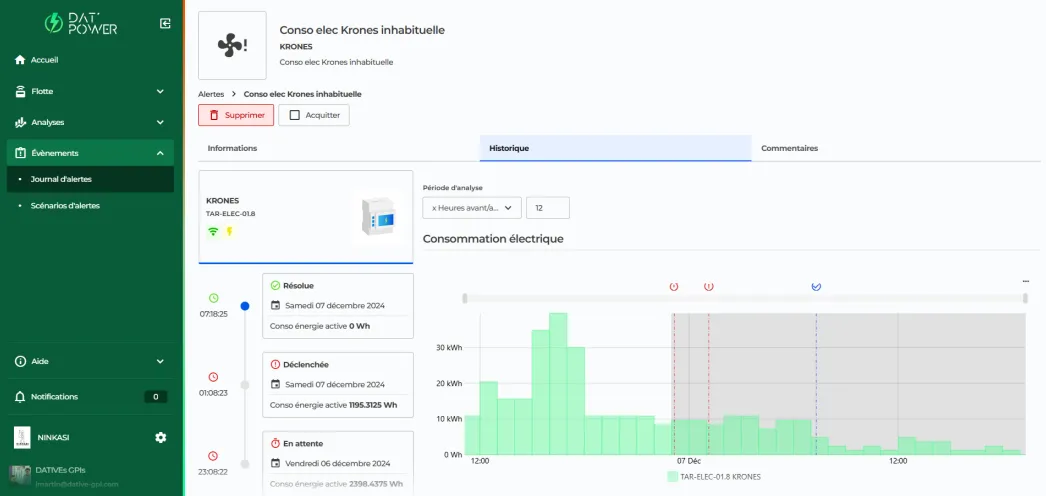
We configure dashboards by role in DAT’Power to provide each department with actionable data views.
Management: Strategic objectives, consolidated financial costs, and site-by-site performance trajectories.
Energy Management: IPE per UES, drift analysis, daily financial impact, action priorities, and tracking progress.
Maintenance Teams: Real-time alerts, system statuses, prioritized maintenance tasks, baseload anomalies.
Commissioning and Key User Training
We perform functional commissioning per UES, verifying sensors, calculations, and alarm limits. Site managers, energy managers, and maintenance personnel receive dedicated training on workflows for alerts, drift detection, and escalation procedures.
Example rule: If the baseload on the compressed air UES exceeds X kWh for Y consecutive hours, notify the maintenance team, generate an issue ticket, and track the corrective action.
Monitored metrics: sensor coverage on critical UES, alert SLAs based on process impact, and completion rates of action items within set targets.
Expected Results and Benefits for the HVAC Manufacturer
Using DAT’Power, the production site monitors individual UES performance (CEE, heat pumps, compressed air, boilers) using standardized indicators to optimize consumption.
Reduced Consumption per UES: Interrogating IPE values and drift metrics enables rapid corrective actions, stabilizing energy baselines.
Improved Responsiveness: Dynamic alerts enable same-day interventions rather than waiting for end-of-month reporting, reducing utility costs and mitigating process risks.
Process Stabilization: Continuous monitoring of CEE and heat pumps reduces process variance, maintaining consistent testing environments.
Traceability: Consolidated data supports efficiency reporting, internal audits, and satisfies CEE prerequisites for eligible actions (sheet IND-UT-134, subject to scope).
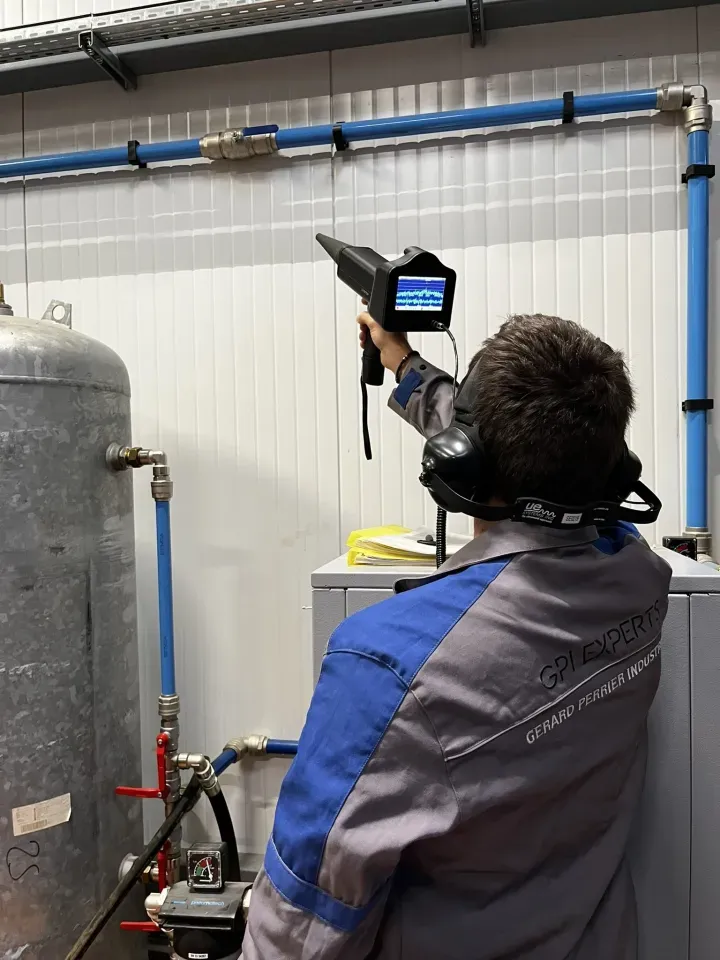
Practical application: In the utilities workshop, DAT’Power detected an anomalous baseload on the compressed air network. Corrective adjustments reduced the baseload by over 15%, improving overall compressor efficiency.
Read our technical guide on optimizing industrial compressed air networks.
Monitored metrics:
IPE per UES (kWh per production unit or Nm³)
Daily financial savings post-intervention
Leakage rate relative to target threshold
Our energy engineers are available to provide an initial assessment of potential savings and ROI based on your facility's energy profile.
Further reading: The role of IIoT in industrial energy management
Future Phases and Scalability
Remote Lighting Control: DAT’Power GTB/GTC
DAT’Power supports both energy monitoring and active control. Utilizing LoRaWAN dry contact relays, the system manages simple electrical loads like lighting installations, using schedules, motion tracking, or occupancy sensors.
The HVAC manufacturing site is integrating this module, transitioning DAT’Power into an extensible GTB/GTC system, beyond standard logging applications.
Read our technical analysis for industrial sites subject to the BACS Decree to see how DAT’Power supports compliance.
Transitioning to Predictive Maintenance with DAT’Process
While preventive and scheduled maintenance address known wear cycles, predictive maintenance analyzes weak signals to anticipate equipment failure or drift. Using our DAT’Process industrial monitoring module, engineers correlate load/no-load cycles, operating temperatures, and vibration analysis to predict maintenance requirements on compressors, CEE, and heat pumps.
Use Case: Detecting abnormal vibration signatures on a compressor combined with elevated run-time at zero-load allowed operators to schedule belt replacement before mechanical failure occurred, avoiding production downtime and excessive energy draw.
Contact our technical team to learn how DAT’Process integrates predictive maintenance into your operations model.
Conclusion
Through DAT’Power, the HVAC manufacturer tracks system-level consumption across critical UES, visualizes operating drift in real time, and acts on automated alerts. This deployment yields measurable financial savings, stabilizes performance on CEE and heat pump systems, and provides objective data for audits and efficiency planning.
Future steps include extending the sensor network, controlling auxiliary equipment (such as lighting arrays) via LoRaWAN relays, and utilizing the DAT’Process platform to diagnose thermal and mechanical deviations. This establishes a long-term energy and maintenance management architecture.