ISO 50001: Implementing an EnMS to monitor and optimize your energy consumption

Quentin Schroter
•
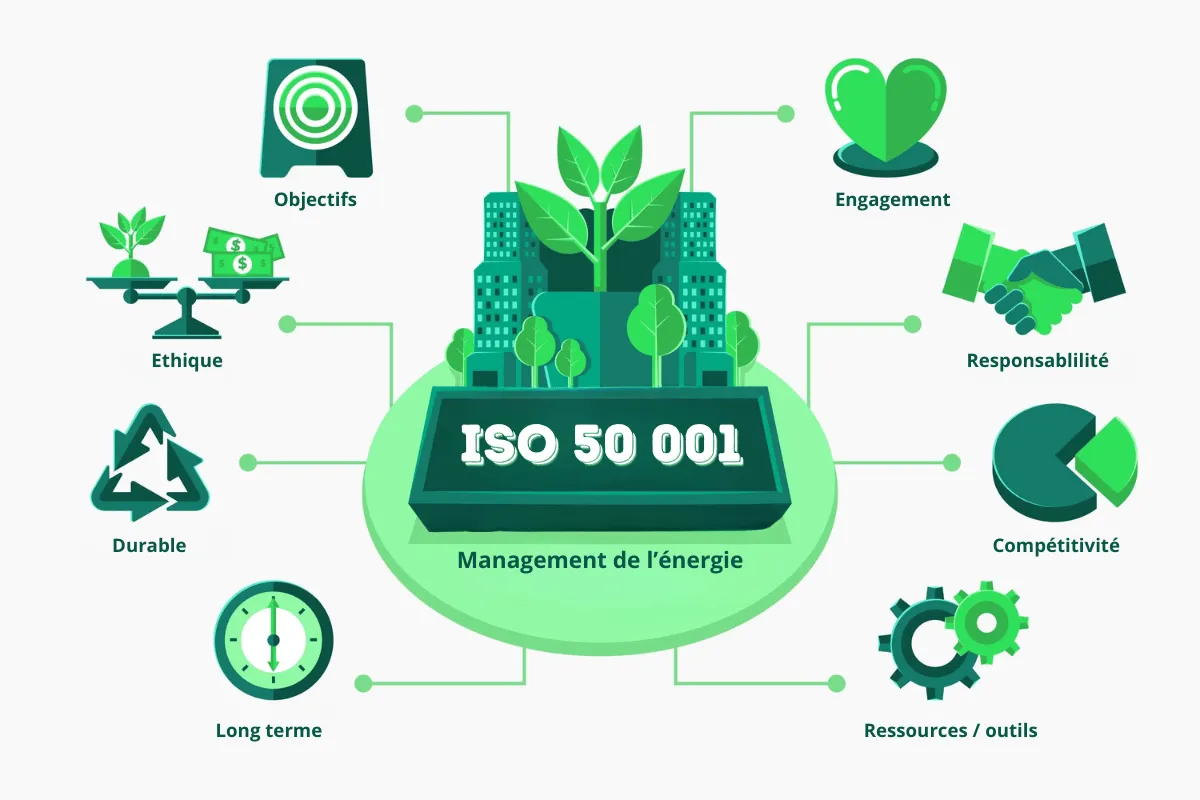
In the current economic and environmental context, energy performance under the NF EN ISO 50001 standard is an effective lever for controlling costs in companies. It reduces energy bills and leads to a reduction in greenhouse gas emissions, also allowing organizations to contribute to their environmental and societal commitments. The ISO 50001 standard is therefore a strategic solution for optimizing energy management.
ISO 50001: obligations and compliance for optimized energy performance with an EMS |DATIVE
This article explores legal obligations, the sectors concerned, the requirements of the standard, and the key steps to compliance. It also presents the advantages and challenges of ISO 50001, with the support of DATIVE.
Objectives of the ISO 50001 standard
Main objectives
ISO 50001 establishes a methodical approach to help energy-intensive companies and organizations structure and improve their energy management. Based on an Energy Management System (EMS), this standard provides a rigorous framework for monitoring, analyzing, and optimizing the use of energy resources, thereby promoting more efficient and sustainable management.
The main objectives of ISO 50001 are as follows:
Continuous improvement of energy performance: the standard encourages companies to adopt a structured approach to optimize their energy consumption.
Reduction of energy costs: by following ISO 50001 guidelines, companies can identify waste and implement corrective actions.
Reduction of carbon footprint: by reducing energy consumption, companies contribute to climate goals and corporate social responsibility commitments.
Integration into corporate strategy: the standard facilitates the alignment of energy policies with the strategic objectives of the organization.
Regulatory compliance: it ensures compliance with legal requirements regarding energy efficiency, allowing companies to anticipate regulatory developments and shield themselves from mandatory audits (see FAQ).
Reduction of carbon footprint: by reducing energy consumption, companies contribute to climate goals and corporate social responsibility commitments.
Stakeholder engagement: it promotes awareness and involvement of employees, suppliers, and customers in the company's energy approach.
Contribution to access to grants and funding: ISO 50001 certification can strengthen the structuring of energy management in companies, which can indirectly facilitate access to financial aid and contribute to obtaining Energy Savings Certificates (CEE).
Audience
The NF EN ISO 50001 standard is intended for a broad audience, including companies of all sizes, public authorities, and private institutions. It is particularly relevant to industries, large energy consumers, and organizations wishing to optimize their energy consumption.
Expected impact of compliance
Companies that adopt ISO 50001 benefit from several concrete advantages. By optimizing their energy consumption, they:
achieve substantial savings on their bills
significantly reduce their CO2 emissions
and strengthen their commitment to sustainable development
This compliance is part of a broader dynamic supported by the State, notably through programs such as PACTE Industrie as well as ADEME support schemes, which encourage companies to adopt more responsible energy practices.
Scope of application of the ISO 50001 standard
Sectors concerned
ISO 50001 applies to a wide range of sectors, including industry, healthcare, transport, commercial buildings, and critical infrastructure. It also applies to large manufacturing companies, local authorities, and SMEs wishing to optimize their energy efficiency.
Types of organizations or activities targeted
All companies, regardless of size and activity, can adopt this standard to structure and optimize their energy management. It is particularly beneficial for organizations with significant energy consumption.
Technical or geographical scope
ISO 50001 is an international standard applicable to any organization, regardless of its location. Its technical scope requires that the energy management system covers at minimum 80% of the organization's energy bills.
Overview of requirements and chapters of the ISO 50001 standard
Implementation of an Energy Management System (EMS)
ISO 50001 is based on the implementation of a structured EMS to manage, monitor, and improve the energy performance of an organization. This system defines processes to measure, monitor, and control energy consumption while establishing continuous improvement plans. Read our article on this topic.
Definition of energy objectives
Companies must establish energy management objectives and targets. These targets must be realistic, measurable, and aligned with the overall strategy of the organization.
Monitoring and analysis of energy performance
ISO 50001 requires rigorous monitoring of key performance indicators (KPIs) related to energy consumption. This includes the use of measurement tools, energy data analysis, and the identification of improvement opportunities.
Action plan and continuous improvement
One of the fundamental principles of ISO 50001 is the continuous improvement of energy performance through the PDCA cycle (Plan-Do-Check-Act). This process allows ongoing optimization of energy efficiency and ensures sustainable results.
Management commitment and stakeholder involvement
The implementation of this standard requires a strong commitment from management as well as team involvement. Raising employee awareness of best practices and energy management is essential to ensure the success of the EMS.

Implementation and compliance of the ISO 50001 standard
Key steps to compliance
The ISO 50001 standard relies on the PDCA cycle to ensure continuous improvement of energy performance:
Plan: appoint an Energy Manager, define an energy policy with clear objectives, and prioritize significant energy uses (UES).
Do: implement the defined actions, allocate the necessary resources, and deploy an Energy Management System (EMS) to structure efforts.
Check: monitor key performance indicators (KPIs) to validate original results and measure action efficiency using technological tools.
Act: adjust strategies, correct detected anomalies, and define new objectives to keep progressing.
A well-structured EMS ensures optimal energy management and allows companies to reduce costs sustainably while strengthening regulatory compliance.
Best practices
To ensure the effectiveness of ISO 50001, companies must adopt tools and methods adapted to their activity. A high-performing EMS relies on:
An adapted tech infrastructure: use of smart sensors, connected meters, and energy analysis software.
Real-time monitoring: identification of priority consumptions and implementation of alerts to detect deviations.
Expert guidance: support from specialized consultants to ensure compliance and optimization of the EMS.
Team engagement: raising employee awareness and training personnel in energy efficiency to foster a culture of continuous improvement.
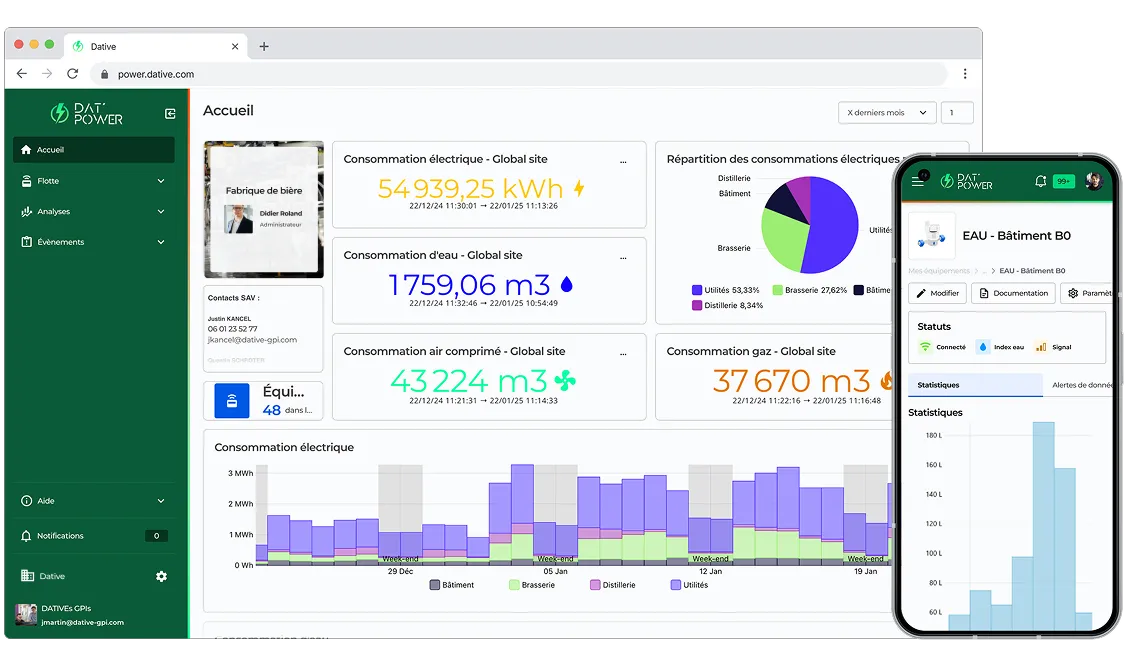
DATIVE, an expert in energy management, offers a turnkey solution that meets the requirements expected of an EMS through DAT’POWER, a platform designed to structure, optimize, and continuously monitor company energy performance.
Resources and tools available
DATIVE offers companies personalized support for the implementation of their EMS by providing adapted solutions:
An integrated and optimized multi-site management: facilitating rights administration, reporting (audit, PSH, tertiary decree, BACS), and data analysis (correlation of data / IPE...).
A la carte support: covering all phases of the project and adaptable to the maturity of each site.
Real-time monitoring and efficient data centralization: via our interoperable, multi-source, multi-protocol, and multi-energy platform (integrating existing tools / equipment).
An advanced alert system: allowing anticipation of anomalies and leak detection through notifications, SMS, emails, etc.
On-site expertise: installation of sub-meters and sensors with reliable, open hardware from recognized market suppliers (Socomec, Adeunis, Itron, Tektelic, Endress+Hauser, etc.).
A robust and scalable solution: integrating new features, monitoring regulations, as well as AI and LLM advancements for increasingly optimized energy management.
With the expertise of the Gérard Perrier Industrie group, DATIVE helps turn energy management into a strategic and sustainable lever for your company.
Implement a high-performing and scalable EMS with Dative!
Relationship with other standards
Complementary or related standards
ISO 50001 was developed based on the same principles as ISO 14001, facilitating its integration within a global management system.
The related standards are:
ISO 14001 (Environment): covers all environmental impacts, including energy consumption, aiming to limit resource depletion and emissions associated with their use. However, ISO 14001 certification does not exempt from the mandatory energy audit.
BACS Decree (Building Automation & Control Systems): mandates the installation of building management systems (BMS) to optimize energy consumption in commercial buildings.
Tertiary Decree: requires commercial buildings to progressively reduce their energy consumption, with target objectives by 2050. Industrial sites may also be affected.
APER Decree (Reinforced Energy Audit and Savings Plan): strengthens energy audit obligations for high-consumption companies and mandates an action plan to improve energy performance.
Comparison with other standards
ISO 50001 stands out from other energy efficiency standards due to its structured and certifiable approach. Unlike national standards, it guarantees international recognition.
Evolution and current news
Version history and updates
ISO 50001:2011: first version introduced to help companies structure and improve energy management through an Energy Management System (EMS).
ISO 50001:2018: major update integrating the High-Level Structure (HLS), making it easier to integrate with other management standards such as ISO 9001 and ISO 14001. It also strengthens requirements for monitoring and continuous improvement.
Future trends
Digitalization and IoT: development of connected technologies for real-time monitoring of energy consumption, allowing more proactive and precise management.
Artificial Intelligence (AI) and LLM (Large Language Models): advanced usage of energy data through AI and language models to identify optimizations and automate decision-making processes.
Strengthening of regulatory requirements: progressive alignment with international climate goals (Paris Agreement, Fit for 55, CSRD) to encourage an accelerated and more ambitious energy transition.
Increased interoperability: development of solutions compatible with multiple protocols and platforms for integrated energy management, adapted to multi-site and multi-energy environments.
Automation and predictive analysis: growing integration of predictive algorithms to anticipate energy anomalies and optimize performance in real time.
Benefits and challenges of the ISO 50001 standard
Benefits for companies
Cost reduction: optimized energy management enables 10 to 20% savings on bills.
Lower carbon impact: reduction of CO2 emissions and strengthened commitment to climate action.
Competitive advantage: certification validates sustainable commitment to clients and partners.
Quick return on investment: achieved savings rapidly offset implementation costs.
Increased competitiveness: lower energy expenses result in higher profitability and innovation potential.
Regulatory compliance: anticipates legal evolutions and bypasses certain obligations such as the mandatory energy audit.
Stakeholder mobilization: raises awareness and engages employees, suppliers, and customers in a responsible energy approach.
Facilitation of access to CEE grants: the establishment of IPE performance indicators is facilitated with an EMS tool, enabling CEE acquisition through the IND-UT-134 sheet.
Challenges or limitations
Although ISO 50001 offers numerous advantages, its implementation can present certain challenges:
Initial investment: costs related to establishing an EMS and acquiring certification can be a barrier for some companies.
Organizational change: the standard requires adaptation of internal processes, calling for employee training and awareness.
Regular monitoring: constant control of energy performance is required to guarantee continuous improvement.
Time commitment from teams: compliance calls for a significant commitment from internal teams, involving time and dedicated human resources.
Resources and references
To deepen your understanding of ISO 50001 and benefit from effective support in its implementation, here are some useful resources:
Official ISO website: detailed presentation of the standard and its updates - ISO 50001 - Energy Management
Ministry of Ecological Transition: official information on public policies and measures related to energy performance improvement - NF ISO 50001 standard and energy performance
ADEME (French Agency for Ecological Transition): support for companies with financial assistance for energy optimization and EMS implementation. Discover also their detailed guide on the implementation of an Energy Management System according to ISO 50001: Implementation of an EMS according to ISO 50001.
FAQ
Question 1: Is ISO 50001 mandatory?
No, but some companies may be encouraged to implement it to meet regulatory requirements or access funding.
Question 2: How long does it take to get certified?
This depends on the size and complexity of the company, but on average between 6 and 12 months.
Question 3: What is the average return on investment?
Achieved savings generally enable amortization within 2 to 5 years, depending on the implemented actions.
Question 4: Is an energy audit mandatory without ISO 50001 certification?
Yes, for large companies (more than 250 employees, a turnover exceeding €50M or a balance sheet of over €43M), an energy audit is mandatory every 4 years according to the NF EN 16247 standard. Non-compliance exposes these companies to financial penalties of up to 2% of their turnover, and 4% in case of recurrence, imposed by the DREAL.
Question 5: Does ISO 50001 certification provide an alternative to the energy audit?
Yes, ISO 50001 certification constitutes an alternative to the NF EN 16247 energy audit.